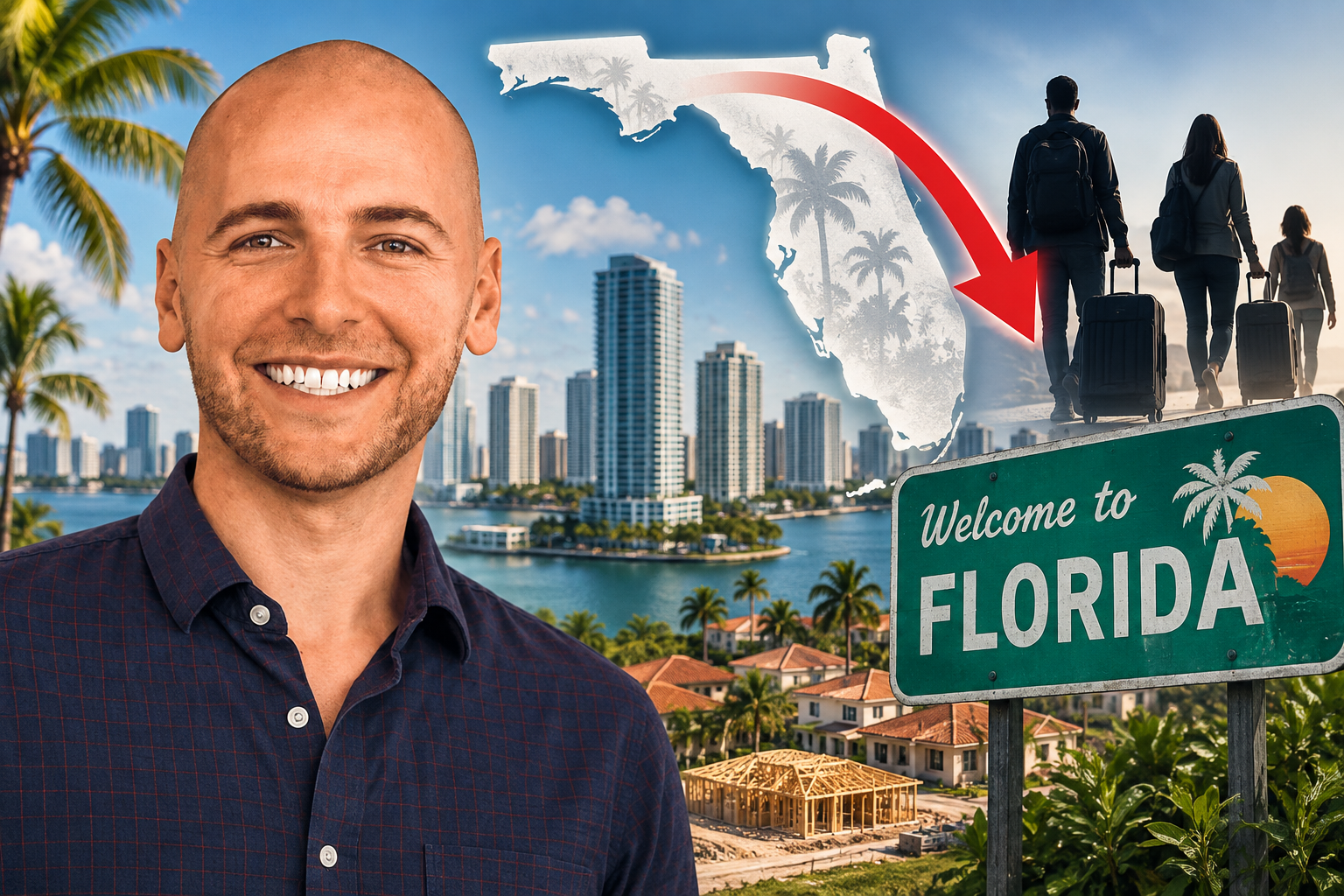
Florida’s migration reversal is getting ugly.
Tampa, Orlando and Miami all recorded negative migration in Q2 2026, according to the Bank of America data cited in this analysis. Orlando and Miami even performed worse than New York.
That’s a remarkable reversal.
Only a few years ago, Florida was America’s migration boomtown. Hundreds of thousands of people were relocating to the state, homebuilders were expanding rapidly, and housing prices exploded.
Now that growth engine is sputtering.
And that’s a major problem for a housing market built around continued population growth.
The Florida Pandemic Migration Boom didn’t just push home prices higher. It encouraged builders, investors, and businesses to make decisions assuming people would keep coming. The latest migration data shows just how dramatically that assumption is changing. Bank of America data for Q2 2026 shows Tampa, Orlando and Miami on the negative side of the migration ledger, with Orlando and Miami recording larger outflows than New York.

What happens when they don’t?
Florida Pandemic Migration Boom Is Going Into Reverse
Some corners of the real estate industry have started talking about a Florida housing recovery.
The evidence?
Inventory has declined from last year’s highs.
But there’s a problem with that argument.
Inventory isn’t falling because buyers suddenly came flooding back into the market. Much of the decline appears to be coming from homeowners withholding listings, delisting properties, or deciding not to sell.
Demand remains extremely weak.
Florida recorded roughly 32,000 home sales in July 2026, putting sales near the lowest July levels of the last 13 years.
Transactions remain approximately 30% below the pandemic peak and well below pre-pandemic levels. The sales data makes it difficult to call this a meaningful housing recovery. Florida recorded roughly 32,100 home sales in July 2026, compared with around 46,100 at the 2021 peak and roughly 40,400 in 2019.

So this isn’t a normal housing recovery.
Sellers are simply pulling back at the same time buyers remain on the sidelines.
And now migration is creating another problem.
Orlando Went From Migration Boom to Population Loss
Orlando provides one of the clearest examples of how dramatically conditions have changed.
At the peak of the Florida Pandemic Migration Boom, domestic migration into the Orlando metro reached approximately 36,800 people in 2022.
Then it collapsed.
By 2025, Orlando’s net domestic migration had fallen to approximately -1,700, according to the figures in this analysis. The historical series shows how abrupt the reversal has been. Orlando gained approximately 36,800 domestic migrants in 2022, but within only three years, that pandemic-era surge had completely disappeared and migration had turned negative.

That was reportedly the metro’s second-worst domestic migration performance on record.
Think about that reversal.
Orlando went from gaining nearly 37,000 domestic migrants annually to losing residents within three years.
That’s not a small change for the housing market.
Orlando experienced enormous home-building activity based partly on expectations of continued population growth. Builders added supply while rising demand pushed prices to levels that became increasingly difficult for local incomes to support.
Now, the population growth that helped justify that construction is disappearing.
Users can track domestic migration trends for their own county through the Reventure App, alongside inventory, prices, and other local housing indicators.
Tampa Is Showing the Same Migration Reversal
Tampa tells a remarkably similar story.
Historically, the metro has attracted roughly 30,000 net domestic migrants per year during strong migration periods.
In 2025, that figure fell to approximately -1,500. Tampa’s decline is arguably even more striking because strong domestic migration has been such a consistent feature of the metro’s growth. After routinely gaining tens of thousands of Americans per year—and more than 50,000 around the pandemic peak—the metro moved into negative territory in 2025.

According to the underlying analysis, that was Tampa’s worst domestic migration performance on record.
Some people might look at these numbers and argue that the percentage population decline remains relatively small.
But that misses the point.
Florida’s economy doesn’t need a massive population decline for housing conditions to deteriorate.
It needs the growth machine to stop.
Why Negative Migration Is Such a Big Problem for Florida
Florida has built enormous portions of its economy around population growth.
Homebuilders need new households.
Contractors need construction.
Real estate agents need transactions.
Developers need buyers.
And local businesses need an expanding population.
When tens of thousands of new residents arrive every year, that system works extremely well.
When migration suddenly approaches zero or turns negative, the economics change quickly.
That’s especially problematic when builders have already created supply based on expectations of continued growth.
Florida’s labor market may already be reflecting some of that slowdown.
The statewide unemployment rate has increased to approximately 4.6%, up substantially from the pandemic-era low around 2.8%. Florida’s labor market has weakened at the same time its migration and housing booms have cooled. The unemployment rate has climbed from roughly 2.8% in 2023 to 4.6% by July 2026, reversing much of the post-pandemic labor-market strength.

A 4.6% unemployment rate isn’t historically catastrophic.
But the direction matters.
Migration has collapsed. Housing transactions remain depressed. And unemployment has risen.
Those trends are increasingly difficult to separate.
Florida Housing Became Too Expensive
Florida works best when its housing market is reasonably affordable.
Local households need to be able to buy homes.
Upper-middle-income households from other states need to see Florida as an attractive place to relocate.
Retirees need to be able to sell their existing home and comfortably purchase another property in Florida.
And second-home buyers need the economics to make sense.
The pandemic disrupted that balance.
Home prices surged. Mortgage rates eventually increased. Insurance premiums climbed. Property taxes and other ownership costs became increasingly difficult for many households to absorb.
Eventually, the affordability advantage that helped attract people to Florida began disappearing.
And when Florida becomes too expensive, something important happens.
Locals don’t simply stop buying.
Some leave.
Meanwhile, prospective retirees and interstate movers can postpone their relocation for several years.
That destroys the constant flow of demand that Florida’s housing market became accustomed to.
Florida’s Migration Collapse Looks Uncomfortably Familiar
The historical comparison is where this gets more concerning.
The last major period when Florida’s domestic migration fell this dramatically was around the 2008 housing crash.
According to the figures cited in the analysis, only about 22,000 net domestic migrants moved into Florida during 2025.
That represented one of the weakest readings in decades. The longer-term history puts that number into perspective. Florida gained roughly 310,000 domestic migrants in 2022, but that figure collapsed to around 22,500 by 2025—a decline of more than 90%. The only similarly dramatic migration collapse visible in recent decades occurred around the 2008 housing downturn.

It doesn’t mean Florida is automatically heading for another 2008-style crash.
But the similarity matters because the underlying housing-market dynamic is familiar.
Rapid population growth encourages construction and pushes prices higher.
Affordability deteriorates.
Migration slows.
Demand weakens.
And suddenly, the market has more housing capacity than its previous growth assumptions can justify.
That can put downward pressure on both construction and prices.
Could Florida Housing Fall Again in 2027?
We still don’t have complete Census migration data for 2026. That data should provide a clearer picture when updated estimates become available.
But preliminary indicators aren’t encouraging.
Bank of America data cited in the underlying analysis showed Tampa, Orlando and Miami remaining negative on migration during Q2 2026.
That suggests the 2025 slowdown may not have been temporary.
And if migration remains weak into 2027, Florida’s housing market could face another difficult year.
Inventory falling because sellers withdraw homes isn’t enough to create a sustainable recovery.
Florida needs buyers.
And historically, a huge source of those buyers has been new residents moving into the state.
Until affordability improves enough to attract those households again, the Florida Pandemic Migration Boom is unlikely to return.
That could require lower mortgage rates.
Higher incomes would help.
But increasingly, the adjustment Florida’s housing market may need is the one sellers least want to hear about: lower home prices.