The Orlando, FL housing market is flashing warning signs as we head into 2025. Inventory has surged to levels not seen since the 2008 crash, yet buyer demand remains notably weak. Moreover, sellers appear increasingly eager to offload properties, hoping to cash out before prices slide further. A key indicator of the market’s cooling trend is the steep decline in investor activity. Let’s explore Orlando’s housing market situation in detail:
Investor Pullback in Orlando Raises Market Risks for 2025
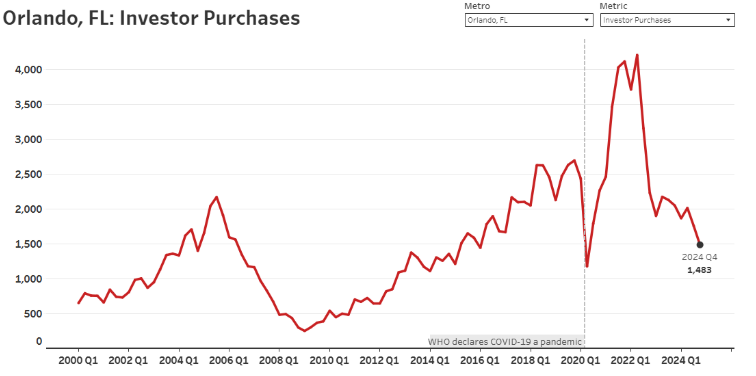
Redfin data shows investor purchases in Orlando fell to just 1,483 in Q4 2024, down nearly 65% from their peak of over 4,000 in early 2022. This is the lowest investor activity the city has seen in nearly a decade, highlighting growing concerns about market stability.
Investor purchases in Orlando fell to 1,483 in Q4 2024, the lowest level in nearly a decade. (Source: Redfin)
This sharp drop in investor activity is depriving Orlando’s housing market of a critical source of demand, further weakening an already fragile market. The last time purchases fell this steeply was just before the 2008 housing crash when home values in the city plummeted by nearly 50%. With history threatening to repeat itself, the current decline in investor confidence should raise serious red flags for potential buyers heading into 2025.
Orlando, FL’s Housing Inventory Trends by County in 2025
In 2025, Orange County leads the Orlando metro area with the highest number of homes for sale at 5,249, showing a significant year-over-year (YoY) sales inventory growth of 55.9% and a price cut percentage of 32.7%. This large spike in inventory, while offering buyers more options, also reflects a cooling market with sellers making notable concessions.
Osceola County follows with 4,186 homes for sale, a 34.2% increase in inventory YoY, and the lowest price cut rate among the four counties at 26.3%, suggesting slightly stronger seller confidence compared to its neighbors.
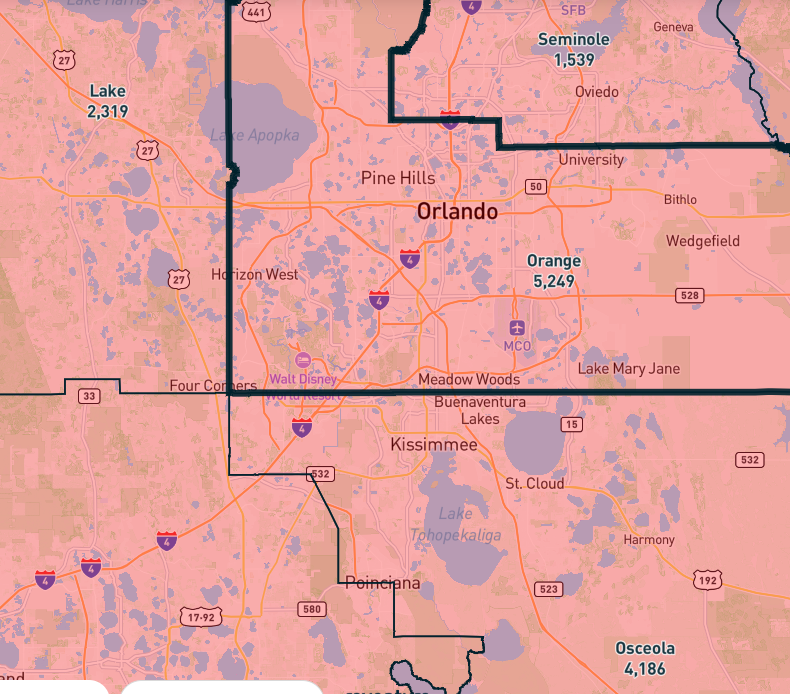
Orange County has the highest inventory as of April 2025 in the Orlando Metro. Access the above map here. [Link]
Seminole and Lake Counties also show signs of a cooling housing market. Seminole has the lowest inventory at 1,539 but a high inventory growth of 48.1% YoY and a price cut percentage of 34.9%, indicating weaker demand. Lake County’s inventory sits at 2,319 with 50.3% YoY growth and 33.5% price cuts, both pointing toward rising supply and reduced pricing power for sellers.
Will Investors Return to Orlando in 2025?
Investor interest in Orlando is unlikely to rebound unless home prices fall significantly. Currently, cap rates remain too low to justify new purchases, hovering around 5.6% in 2024 and 2025, a stark contrast to the 8–9% returns seen between 2010 and 2013. This gap between property prices and rental yields means that, for most investors, buying simply doesn’t pencil out. Only if property values drop enough to boost cash flow will investors consider jumping back in.
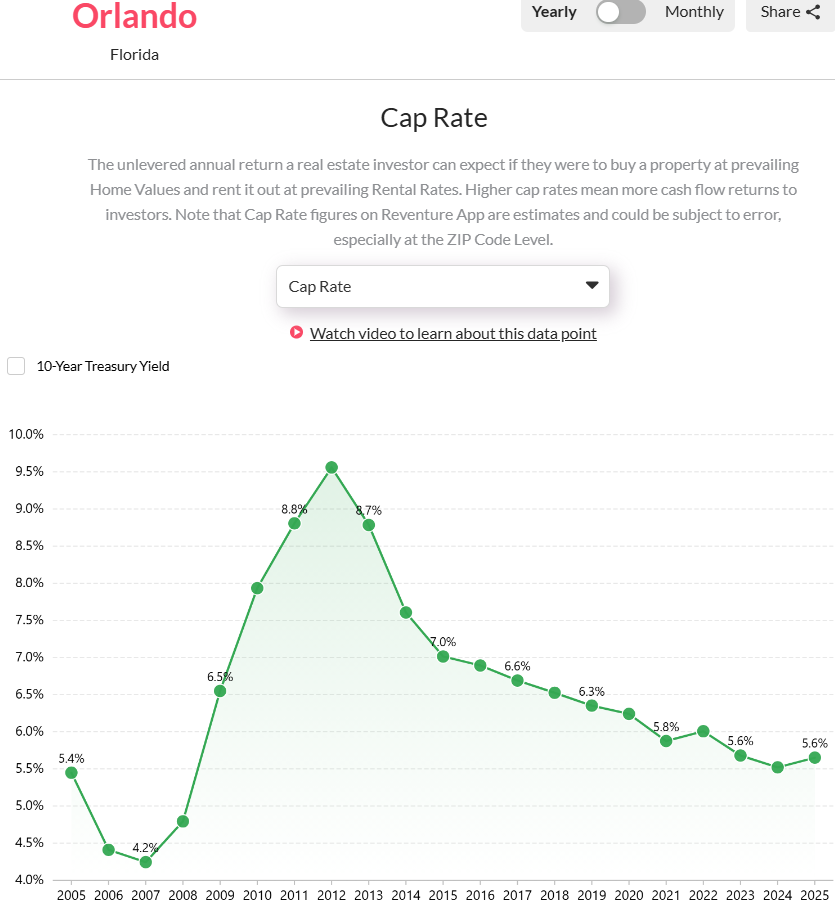
Orlando’s cap rates have dropped to 5.6% in 2025, down from a peak of 9.5% in 2012. Access the above graph here. [Link]
Moreover, while a major housing crash isn’t expected, modest price corrections seem likely. According to current trends and past market cycles, home values in the Orlando metro could decline by up to 5% over the next year. This correction may gradually realign pricing with rental fundamentals. To explore cap rate and other housing market metrics of different metros, sign up for Reventure App’s premium plan for just $39/ month to access in-depth market analytics and tools.
FAQs about Orlando’s Housing Market
1. Is Orlando a Good Place to Invest in Real Estate in 2025?
Orlando’s long-term growth potential remains attractive, but 2025 may bring challenges for investors. Low cap rates and high home prices are making it harder to generate strong rental returns right now.
2. Will Home Prices in Orlando Drop in 2025?
Prices may decline modestly in 2025 as inventory rises and buyer demand weakens. However, most analysts don’t expect a dramatic crash like in 2008.
3. Why Are Investors Pulling Back from the Orlando Housing Market?
Many investors are stepping back due to shrinking profit margins and low cap rates. The current price-to-rent imbalance makes new purchases less appealing for rental income strategies.