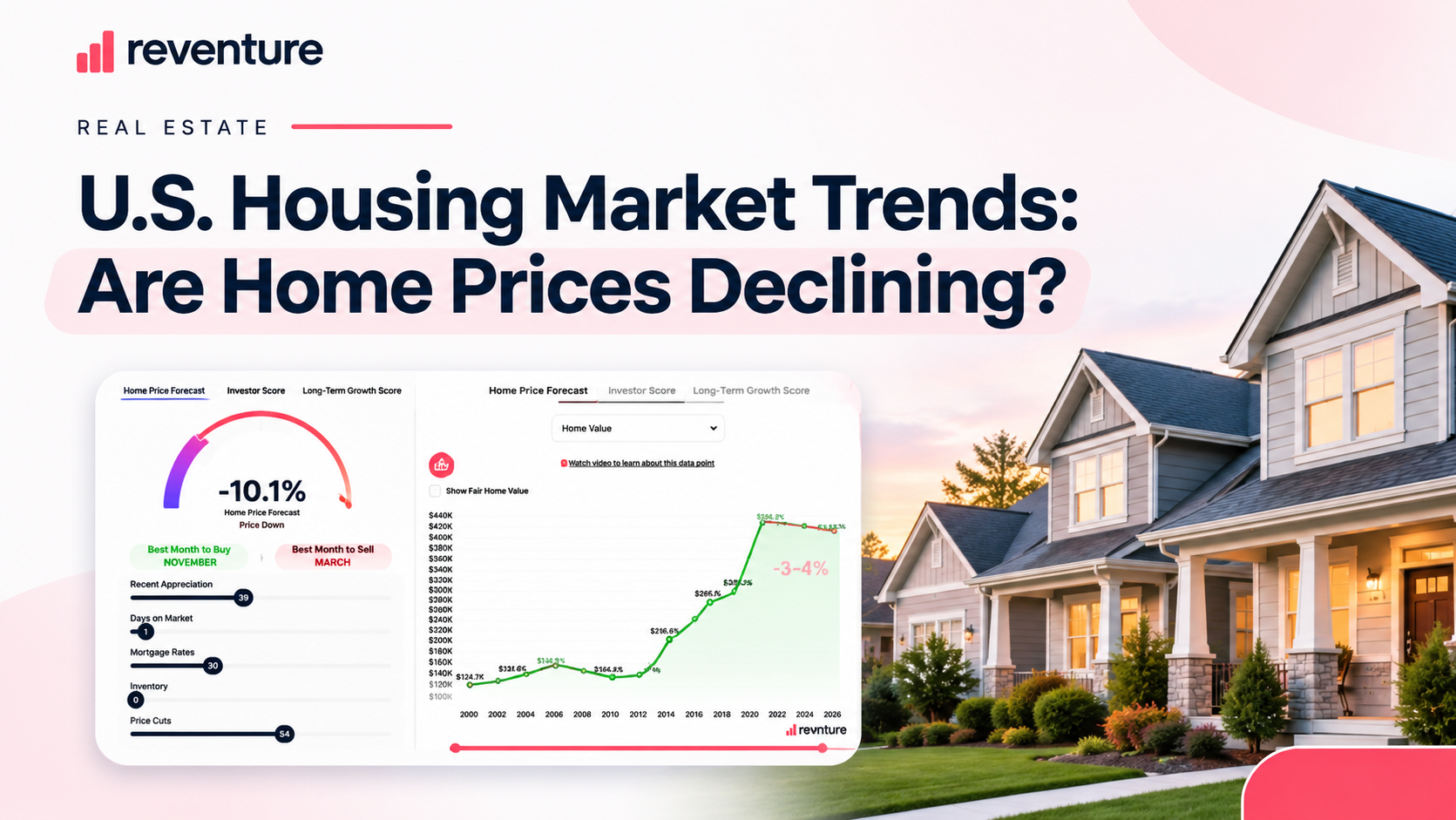
Yes, in many markets housing prices will drop in 2027. Reventure forecasts some ZIP codes, including parts of East Nashville, to fall close to 10% in 2027, driven by high inventory (nearly back to pre-pandemic levels) and a 30-year low mortgage demand. Nationally, expect a slower, uneven decline, not a 2008-style crash.
Key Takeaways:
- The most oversupplied markets are forecast to fall up to 10% over the next year.
- Buyer demand is the weakest in decades: mortgage applications to buy a home are down about 19% from a year ago.
- High prices relative to incomes and rents, not mortgage rates, are keeping buyers away.
- A gradual, market-by-market decline is more likely than a nationwide crash.
How much will home prices drop in 2027?
In the hardest-hit markets, Reventure forecasts declines of 8% to 10% over the next 12 months. One East Nashville ZIP code is forecast to fall 9.9%, on top of the 3% to 4% that values there have already dropped over the past year.
Reventure’s forecasts combine local inventory, price cuts, days on market, and demand trends to project where each market is heading.

How to check the forecast for your market
National forecasts average together thousands of local markets moving in different directions. A small national decline can mean a 10% drop in one ZIP code and rising prices a few miles away. East Nashville is a good example: values are already falling there, while other parts of the same metro look very different.
To see what’s expected where you’re buying, look up your city or ZIP code on the Reventure App map. It shows the price forecast alongside the local data behind it, including inventory, price cuts, and days on market, so you can see why a market is expected to rise or fall, not just the forecast number.

Why are home prices expected to fall?
Three forces are pushing prices down at the same time: buyer demand has collapsed, inventory has recovered, and prices have outrun what buyers can afford.
Buyer demand is near a 30-year low
The Mortgage Bankers Association’s Purchase Index tracks applications for mortgages to buy a home. It fell from 145.1 in early October to 131.4 in the week ending October 30, and purchase applications are now about 19% below the same week last year (Trading Economics, MBA data via Archyde). By Reventure’s analysis, that is the lowest level of mortgage demand since 1995.
This matters because roughly 70% of home sales are financed with a mortgage. When purchase applications fall, sales follow, and unsold homes sit on the market longer.
One caveat: the MBA index is a survey of lenders, not the entire market. It is best read as a strong signal of direction, not an exact count of buyers.
Inventory is back
Three years ago, there were only about 700,000 homes for sale in the U.S., according to Realtor.com. Today there are close to 1.2 million, nearly back to pre-pandemic levels (Reventure).
For years, the argument was that buyers were only waiting for more homes to choose from. That argument no longer holds. In Nashville, inventory is 50% to 60% above normal, and buyers still aren’t coming back.
Prices are too high for buyers
The typical monthly payment to buy a home has climbed to about $2,850, the highest on record. Many buyers simply can’t qualify. Homebuilder Lennar has said that half the people who walk onto its builder lots don’t qualify for a mortgage.
In Davidson County, home to Nashville, the median household income is about $87,000. At today’s prices, a new home can cost $4,000 or more a month, close to $50,000 a year in mortgage payments alone.
Isn’t it mortgage rates holding the market back?
No. Prices, not rates, are the main problem. The 30-year fixed rate was between 7.3% and 7.5% in October (Trading Economics), and that is historically normal. In the 1990s, rates of 8% to 9% were common, and buyers kept buying.
Reventure’s audience agrees. When asked what the number one problem in the housing market is:

A second poll asked what maximum mortgage rate people would accept to buy at today’s prices. 56% said 4%, and another 22% said 5%. That means nearly 80% won’t buy at current prices unless rates fall below 5%. Only 9% would buy at 7% or higher.
If most buyers are already out of the market at anything above 5%, a move from 6.5% to 7.5% doesn’t change much. What brings buyers back is lower prices.
The 50% gap between renting and owning
The Opendoor home shows the biggest problem in today’s market: before it sold, it was listed for rent at $1,850 a month. Buying it at the current price, with a mortgage, taxes, and insurance, would cost about $2,700 a month.
That makes owning about 50% more expensive than renting the same house. As long as that gap exists, many buyers will keep renting and wait for prices to come down.

Will housing prices crash in 2027?
A nationwide, 2008-style crash is unlikely. Expect a slower, multi-year decline instead, with the steepest drops concentrated in oversupplied markets.
The main reason is that most homeowners aren’t being forced to sell. U.S. homeowners hold about $35 trillion in equity. Mortgage delinquencies have risen over the past year, but the overall delinquency rate of 4.37% is close to pre-pandemic levels (MBA). The stress is concentrated among FHA borrowers, whose delinquency rate is 11.79%, against 2.72% for conventional loans (HousingWire).
Without a wave of forced sales, prices tend to fall slowly. Many sellers, especially those who bought between 2020 and 2023, still expect prices their homes won’t get. Some listing agents promise high prices to win listings, planning to cut later. The result is a market where few homes sell and prices come down gradually, even though buyers may need prices 20% to 40% lower in some areas before they return.
That large equity cushion cuts both ways. It protects owners from a crash, but it also lets them hold out on high prices, which keeps sales low and stretches the correction out over several years.
What could keep prices from falling?
A few things could slow or stop the decline:
- A sharp drop in mortgage rates. Rates falling well below 6% would bring some buyers back, though polling suggests most need rates below 5% at today’s prices.
- A stronger economy. Rising incomes would close part of the affordability gap without prices falling.
- Sellers pulling listings. If owners take homes off the market instead of cutting prices, inventory would shrink and support prices, though sales would stay low.
None of these looks likely to fully reverse the trend in 2027. Rates have recently moved up, not down, and the gap between prices and incomes is too large for a single factor to close.
Which markets could drop the most?
The markets most at risk share the same pattern as East Nashville: inventory well above normal, falling demand, and prices that rose fastest during the pandemic.
Florida and parts of Texas fit that pattern. Florida’s pandemic migration boom has reversed (Reventure), and some North Dallas ZIP codes are down nearly 20% (Reventure).
Forecasts can differ sharply even within a single metro, so check your specific city or ZIP code on the Reventure App map.
What a 10% drop means for buyers
It isn’t necessarily time to buy, but in markets like East Nashville it is time to start making offers, and to build the forecast into them.
Once you know your market’s forecast, use it. If you buy at today’s price in a ZIP code forecast to fall 10%, you could lose that much equity within a year. Your offer should account for where the market is heading, not just where it is today.
For example, take the Opendoor home listed at $368,000. Based on comparable sales, the home’s price history, and the ZIP code’s 9.9% forecast decline, a reasonable offer range is $315,000 to $341,000. The low end is about 14% below the list price.
Fall and winter are often the best seasons to make offers like this. Fewer buyers are looking, and sellers with homes that have sat since summer are more willing to negotiate.
To get an offer range for a specific home, Reventure’s listing analyzer combines comps, price history, and the local forecast into a single recommendation.
Frequently asked questions
How much will home prices drop in 2027?
It depends heavily on the market. Reventure forecasts declines of 8% to 10% in the most oversupplied areas, such as parts of East Nashville. Nationally, expect a smaller, uneven decline.
Will the housing market crash in 2027?
A 2008-style crash is unlikely. Homeowners hold about $35 trillion in equity, and overall mortgage delinquencies are near pre-pandemic levels. A slow, multi-year decline is more likely.
Should I wait until 2027 to buy a house?
In markets forecast to fall, waiting can save money, but you don’t have to sit out entirely. Making offers below asking price now, based on the local forecast, can get you a better deal than paying today’s list price.
Which cities will see the biggest price drops?
Markets with inventory far above normal and weak demand, including parts of Nashville, Florida, and North Dallas, are most at risk. Forecasts differ sharply even within a metro, so check your city or ZIP code on the Reventure App map.
How much below asking price should I offer?
Base your offer on comparable sales, the home’s price history, and the local forecast. In a ZIP code forecast to fall about 10%, an offer 10% to 14% below list price can be reasonable.
Sources
- MBA Purchase Index and mortgage rates, Trading Economics
- MBA weekly applications, week ending Oct. 30, 2026
- MBA National Delinquency Survey, Q2 2026
- HousingWire: Q2 2026 delinquencies by loan type
- Reventure: U.S. housing inventory vs. 2019
- Reventure App forecasts, listing analysis, and audience polls