
Possibly, and for a reason most buyers miss. The Manhattan real estate market went roughly nowhere for ten years while the rest of the country boomed, which has pushed its price-to-rent and price-to-income ratios to the lowest levels on record. Rents are now at an all-time high, inventory is near a decade low, and office demand is returning faster than anywhere else in the country.
Check the 2027 forecast for your ZIP code on the Reventure map to see whether your market is on the same side of this shift.
Key takeaways
- One in three Manhattan condo resales sold at a loss in the year to mid-2025, and Manhattan was the only NYC borough with a negative median resale result in 2025.
- That decade of flat pricing is exactly why the Manhattan real estate market now shows value-to-rent and value-to-income ratios at record lows in Reventure’s data.
- Midtown Manhattan absorbed more office space than any other U.S. market over the past year, at 6.5 million square feet.
- Median Manhattan rent hit a record $5,395 a month in September 2026, with a 1.54% vacancy rate.
- The same shift that helps Manhattan hurts Sun Belt sellers: Reventure forecasts declines of up to 10% in parts of Nashville, Denver, and Dallas.
Why has the Manhattan real estate market underperformed for a decade?
The Manhattan real estate market has been the rare corner of the country where buying and holding lost money. Appraiser Jonathan Miller of Miller Samuel put it plainly: for the last decade, Manhattan has essentially been moving sideways.
The resale data shows what that meant for owners:
| Measure | Result |
|---|---|
| Manhattan condo resales sold at a loss, July 2024 to mid-2025 | 1 in 3 |
| Condos bought 2016–2020 and resold at a loss | More than half |
| Sales above $10 million sold at a loss | 20% |
| Median Manhattan resale result, 2025 | -$24,000 |
| Median NYC resale result, 2025 (all boroughs) | +$70,000 |
Sources: Brown Harris Stevens analysis of 2,500+ condo resales, reported by The Real Deal; PropertyShark 2025 resale data.
Manhattan was the only borough in New York City where the typical seller lost money in 2025. Co-ops closed at a median loss of $11,000 and condos at $58,000. Median price per square foot for Manhattan condos is roughly flat compared with a decade ago.
Inflation makes the picture starker. Reventure’s analysis of Zillow data shows the typical Manhattan home value down about 10% over the past ten years in nominal terms. With cumulative inflation of roughly 40% over that period, that is a decline of close to 50% in real terms.
Several things drove it: a wave of luxury condo construction that added supply at the top of the market, the 2017 cap on state and local tax deductions, the 2019 mansion tax increase, reduced foreign all-cash investment, and the pandemic, which hit dense urban cores hardest.
Is Manhattan real estate undervalued in 2027?
By the two ratios that matter most, yes. A decade of flat prices combined with rents that kept climbing has left the Manhattan real estate market cheaper relative to its own fundamentals than at any point on record. It is the mirror image of the overvalued Sun Belt markets we covered in Will Housing Prices Drop in 2027?.
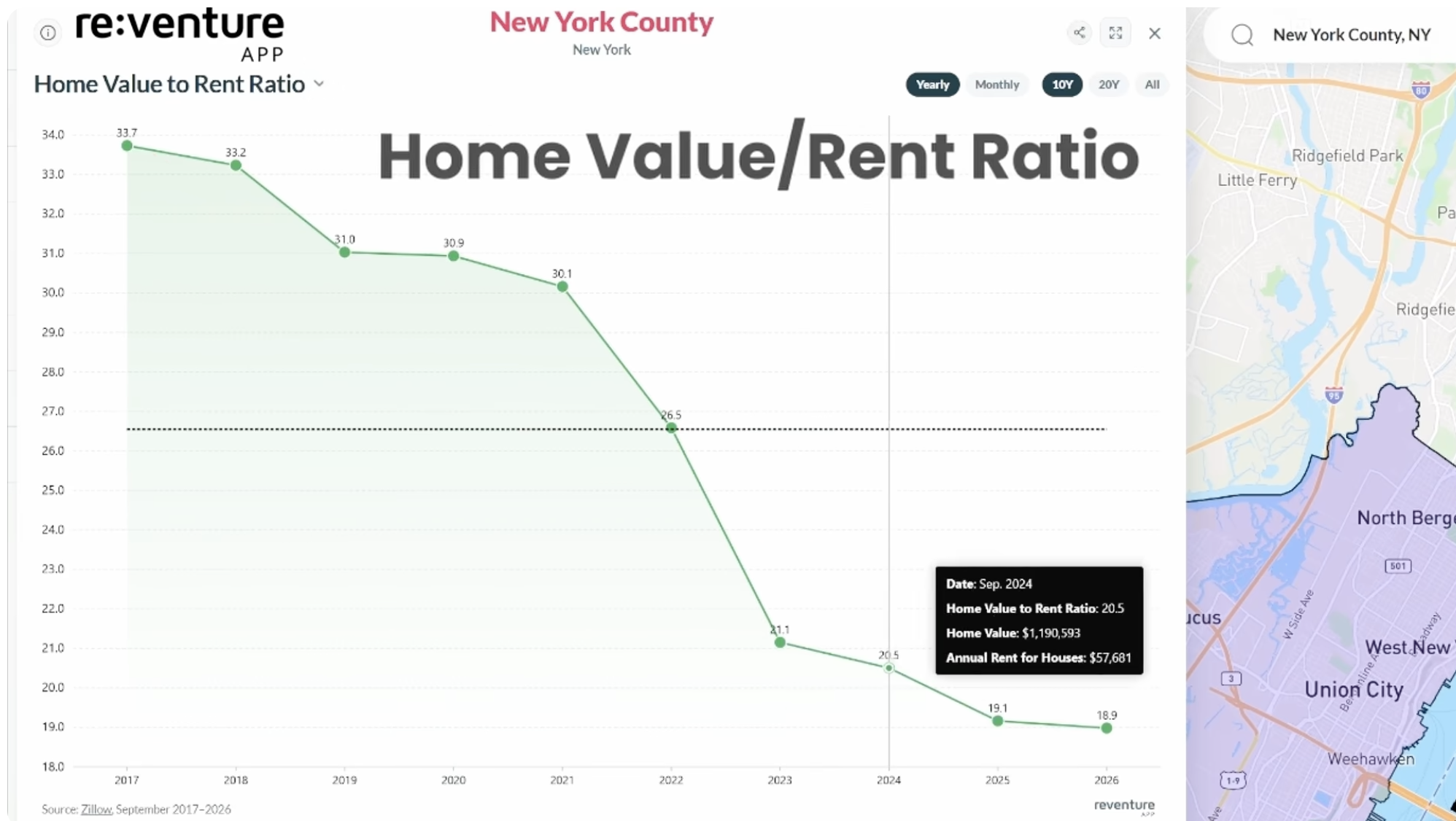
Reventure’s data shows Manhattan’s home-value-to-rent ratio and home-value-to-income ratio both at their lowest levels ever recorded. These are the two measures that determine where prices head over the long run: rents reflect real, current demand for shelter, and incomes determine what buyers can actually pay.
The comparison with the rest of the country is just as striking:
| Period | Manhattan typical value as a multiple of the U.S. typical value |
|---|---|
| About 10 years ago | 7.5x |
| Today | About 3.5x |
Source: Reventure App analysis.
At roughly $1.2 million against a U.S. typical value near $370,000, that multiple is close to its lowest in 25 years. That tells you one of two things is true: either Manhattan is undervalued, or the rest of the U.S. market is overvalued. Reventure’s forecasts suggest it is some of both.
Manhattan is still expensive in absolute terms. A typical condo or co-op still costs over a million dollars. The argument is not that it is cheap. It is that relative to its own rents, its own incomes, and its own history, it is the cheapest it has ever been.
Why is demand returning to New York City?
Jobs are moving back. The clearest evidence is in the office market, which leads housing demand by a year or more because companies sign leases before employees relocate.
Cushman & Wakefield’s Q3 2026 data shows where companies are expanding. Over the trailing four quarters, these were the strongest U.S. office markets by net absorption:
| Market | Four-quarter net absorption |
|---|---|
| Midtown Manhattan | +6.5 million sq ft |
| San Francisco | +3.5 million sq ft |
| Orange County | +2.7 million sq ft |
| Dallas | +2.4 million sq ft |
| San Jose | +2.3 million sq ft |
| Midtown South Manhattan | +1.8 million sq ft |
| Phoenix | +1.7 million sq ft |
Source: Cushman & Wakefield U.S. Office MarketBeat, Q3 2026.
Combined, Midtown Manhattan and Midtown South absorbed 8.3 million square feet, more than any metro area in the country. Add San Francisco and San Jose and the three coastal brain hubs account for a large share of all U.S. office absorption, which totaled 15.5 million square feet nationally.
Vacancy tells the same story. The largest year-over-year declines came in San Francisco (down 410 basis points), Orange County (down 280), Midtown Manhattan (down 260), and Midtown South (down 240).

What is driving the shift back to big cities?
Three forces are working together:
- AI is an agglomeration force. Frontier AI labs, the banks financing them, and the professional services firms serving them cluster in a handful of places. If you want a senior job in tech or finance in 2027, New York and San Francisco are at the top of a very short list.
- Remote work is receding. Many large employers now require three to five days in the office, which re-ties housing decisions to office locations.
- New office supply has collapsed. Just 7.1 million square feet of new office space was delivered in the first three quarters of 2026, roughly one-fifth of the historical average. Sublease availability has fallen 33% from its peak to the lowest level since 2020.
One honest caveat
The Sun Belt has not stopped growing. Dallas and Phoenix both rank in the top seven U.S. office markets for absorption. The shift is one of relative momentum, not a collapse in southern cities. But some individual Sun Belt markets have gone backwards: Houston and Denver recorded negative absorption, and Austin absorbed only a fraction of what it did during its boom.
What are Manhattan rents doing in 2026?
Rents are at an all-time high and still climbing, which is the strongest real-time signal that demand is genuine rather than speculative.
| Metric | September 2026 |
|---|---|
| Median Manhattan rent | $5,395/month (record) |
| Year-over-year change | +9% |
| Vacancy rate | 1.54% |
| Active rental listings | 5,015, down 16% year-over-year |
Source: Corcoran Group NYC Residential Rental Market Report, September 2026.
Rental listings hit their lowest September level since 2019, extending a two-year streak of annual declines. Corcoran’s COO described competition across much of the borough as intense. Average rents rose across every unit type, led by double-digit annual gains in two- and three-bedrooms.
This matters for buyers for a specific reason. When rents rise toward the cost of owning, the financial case for renting instead of buying weakens. In markets where owning costs far more than renting, prices are vulnerable, which is the rent test we applied to Nashville and other falling markets in Is the Housing Market Going Down?. The Manhattan real estate market is moving in the opposite direction.
San Francisco shows the same pattern, with rents up by double digits over the past year, which is part of why Reventure’s forecast for San Francisco County has turned positive.
Are Manhattan home prices going up?
Yes. Prices have risen year over year for six consecutive quarters, and inventory keeps falling.
| Metric | Latest reading |
|---|---|
| Median sales price, Q3 2026 | $1.3 million, up 4% year-over-year, a record for any third quarter |
| Closings, Q3 2026 | 3,625, up 9% year-over-year, strongest Q3 in four years |
| Listed inventory, Q3 2026 | 6,354, down 3% year-over-year, lowest for any Q3 since 2017 |
| Luxury inventory | Down roughly 40% year-over-year, the lowest since tracking began in 2004 |
Sources: Crain’s and Miller Samuel data reported by Habitat Magazine; Miller Samuel via CNBC.
Supply is unlikely to catch up soon. About 52,000 market-rate condo and rental units are expected citywide through 2029, far short of the roughly 70,000 units a year the city estimates it needs. Manhattan’s pipeline is also skewed: close to 3,000 luxury units priced at $2,400 per square foot or more, against only around 170 entry-level units.

What should you know before buying a co-op in Manhattan?
Co-ops make up a large share of Manhattan listings, and they work differently from condos in ways that affect both your odds of buying and your monthly cost.
You buy shares, not real estate. A co-op building is owned by a corporation. You purchase shares in that corporation plus a proprietary lease for your unit. Legally, it is not the same as owning a condo.
The board can reject you. Co-op boards require a detailed financial package and can turn down buyers without explanation. Buyers with smaller down payments or heavier mortgage reliance are rejected most often. Co-op boards have also faced long-standing discrimination complaints over the years.
Maintenance fees are high, but include property taxes. A Manhattan co-op’s monthly maintenance averaged $3,077 in Q2 2026, up 10.2% year over year. That number looks alarming next to a condo’s HOA fee, but it typically rolls your property taxes in. Compare like for like before judging a listing by its fee.
Co-ops are where the discounts are. Co-op price per square foot fell about 10% year over year in Q3 2026, while condo price per square foot rose 3%. Studios in particular can be found at prices close to where they traded twenty years ago. If you can clear a board, this is the discounted end of the Manhattan real estate market, and the same negotiation signals we set out in Is Now a Good Time to Buy a House? apply here: long days on market and more than one price cut.
How do New York City’s housing policies affect buyers?
Two policies introduced under Mayor Zohran Mamdani’s administration matter most to buyers and renters, and their effects so far have been mixed.
The rent freeze on stabilized apartments. Roughly half of New York’s apartment stock is rent-stabilized, with increases set by the city. Those increases were frozen for two years. Stabilized units are difficult to obtain and rarely given up, so the freeze helps existing tenants without expanding supply.
The pied-à-terre tax. This applies a surcharge to second and third homes above a value threshold, starting at $5 million for unoccupied second homes, and can add tens of thousands of dollars a year. Its legal status has been contested in court, so check its current standing before making a purchase decision that depends on it.
Market-rate rents, covering the other half of the apartment stock, rose 9% year over year. Predictions of a wealthy exodus following the 2025 election have not shown up in the data: luxury sales accelerated, inventory fell, and prices set records through 2026. Research from the National Bureau of Economic Research has generally found that tax policy and election outcomes have only modest effects on where wealthy households choose to live.
Affordability remains the open question. Inventory keeps shrinking, vacancy sits near 1.5%, and market-rate rents keep rising, which is a difficult combination for an administration elected on cost-of-living promises.
What are the risks of buying in Manhattan?
The case for Manhattan is a valuation case, and valuation arguments can take years to pay off. The main risks:
- Transaction costs are unusually high. Transfer taxes, the mansion tax, mortgage recording tax, title insurance, co-op flip fees, and broker commissions mean a home needs meaningful appreciation before a resale breaks even.
- Carrying costs are high and rising. Co-op maintenance rose more than 10% in a year. Model several years of increases, not today’s figure.
- A decade of flat prices could extend. “Cheap relative to history” is not a guarantee of a turn. The same was true for several years before now.
- The office recovery is concentrated and could reverse. It rests heavily on AI-driven growth and return-to-office mandates. Both could change.
- Co-op approval is a real obstacle. You can win a negotiation and still be rejected by a board.
- Policy is in flux. Tax treatment of second homes is being litigated, and further changes are possible.
If you want to check out home pricing forecasts in your state, use our Home Price Forecast tool within the Reventure App:

What does Manhattan’s recovery mean for the rest of the country?
If you are not buying in New York or San Francisco, this trend works in your favor as a buyer and against you as a seller.
Housing demand follows jobs. As companies concentrate leasing in coastal hubs, the migration wave that pushed Sun Belt prices up during the pandemic continues to fade. That shows up directly in inventory: supply is near records in Nashville, Denver, and Dallas, while Manhattan and San Francisco County are at or near decade lows. We mapped that national split in detail in Is the Housing Market Going Down? Where Prices Will Fall in 2027.
Reventure’s 2027 forecasts reflect the split:
| Market type | Reventure’s 2027 outlook |
|---|---|
| Parts of Nashville, Denver, Dallas | Declines of up to 10% |
| Most of Manhattan | Positive |
| Long Island and Westchester County | Strongly positive |
| San Francisco County | Recently turned positive |
If you are buying in a Sun Belt market, you have real negotiating power. Inventory is high, buyer competition is weak, and sellers who are still anchored to 2022 pricing will increasingly have to meet the market. Our guide to making offers in a buyer’s market walks through how far below asking you can reasonably go.
If you are selling in Texas, Tennessee, Florida, or Georgia, waiting for a demand rebound is a risky strategy. The job growth that would drive it is concentrating elsewhere, and inventory in those markets is still building.
Check your own ZIP code on the Reventure forecast map before you price a listing or make an offer.
Frequently asked questions
Is Manhattan real estate a good investment in 2027?
By historical valuation measures, the Manhattan real estate market is the most attractive it has been in decades. Price-to-rent and price-to-income ratios are at record lows, rents are at all-time highs, and inventory is near a decade low. High transaction and carrying costs mean it suits long-term buyers rather than short holds.
Why did the Manhattan real estate market lose value for a decade?
A wave of luxury condo supply, the 2017 SALT deduction cap, the 2019 mansion tax increase, reduced foreign investment, and the pandemic’s impact on dense urban cores combined to keep prices flat while the rest of the country appreciated.
Are Manhattan home prices rising now?
Yes. Median sales prices have risen year over year for six straight quarters, reaching $1.3 million in Q3 2026, a record for any third quarter, while listed inventory fell to its lowest Q3 level since 2017.
How much does it cost to rent in Manhattan?
The median rent reached a record $5,395 a month in September 2026, up 9% year over year, with a vacancy rate of 1.54%.
Should I buy a co-op or a condo in Manhattan?
Co-ops are cheaper per square foot and are where the largest discounts sit, but boards can reject buyers and approval requirements are strict. Condos cost more and have appreciated faster recently, but purchases are far more straightforward.
Did wealthy residents leave New York after the 2025 election?
The data does not show it. Luxury sales accelerated, luxury inventory fell to its lowest level since 2004, and median prices set records through 2026.
Which housing markets will fall while New York rises?
Reventure forecasts declines of up to 10% in parts of Nashville, Denver, and Dallas, where inventory is at or near record highs. See Is the Housing Market Going Down? for the full regional breakdown, or check any ZIP code on the Reventure forecast map.
Sources
- Corcoran Group: NYC Residential Rental Market Report, September 2026
- Cushman & Wakefield: U.S. Office MarketBeat, Q3 2026
- Cushman & Wakefield: U.S. office recovery takes hold (October 13, 2026)
- The Real Deal: How likely are losses in Manhattan’s condo market?
- The Real Deal: NYC home resale prices, Manhattan sellers see losses in 2025
- CNBC: One in three Manhattan condo owners lost money when they sold
- Habitat Magazine: High-end co-ops and condos lead 9% third-quarter sales jump
- Habitat Magazine: Condo and rental supply will shrink through 2029
- CNBC: Manhattan luxury real estate sales hold firm
- Housing Notes: 2Q26 Manhattan sales inventory remains lean
- Reventure App: 2027 ZIP code price forecasts, value-to-rent and value-to-income overvaluation metrics, inventory surplus data, and Zillow-based home value analysis
- Reventure video analysis: the migration shift back to New York and San Francisco