Yes, you can negotiate with a home builder in 2027, and right now buyers hold more leverage than at any time since 2012. Nearly half of builders are cutting prices, two-thirds are offering incentives, and new homes are sitting unsold for more than eight months. The best deals go to buyers who know the local forecast, compare price per square foot, and choose wisely between a price cut and a rate buydown.
Key Takeaways:
- Builders are under pressure. 46% cut prices in November 2026, the highest share since the pandemic, and 68% offered incentives.
- The average cut is about 6%, but stale inventory homes, quarter-end deadlines and weak ZIP codes can justify asking for more.
- A price cut and a rate buydown are not equal. A permanent buydown can lower your payment more, but a price cut protects your equity if prices keep falling.
- Use data, not haggling. The ZIP code forecast, resale comps and a rent check give you a fact-based reason for every dollar you ask for.
Can you negotiate with a home builder in 2027?
Yes. In a slow market, you can negotiate with a home builder on the base price, the mortgage rate, closing costs, upgrades and lot premiums. Builders need to keep homes selling to hit quarterly targets, and many have more finished homes than buyers.
The numbers from the National Association of Home Builders (NAHB) survey for November 2026 show how much leverage has shifted:
| Builder survey, November 2026 | Reading | What it means for you |
|---|---|---|
| Builder confidence (HMI) | 25, lowest since April 2012 | Builders are worried about sales |
| Builders cutting prices | 46% | Price cuts are normal, not a special favor |
| Average price cut | 6% | A realistic starting point for your ask |
| Builders offering incentives | 68% | Rate buydowns and closing credits are widely available |
| Buyer traffic index | 16 | Few buyers are visiting model homes |
Source: NAHB/Wells Fargo Housing Market Index, via The Mortgage Reports and Inman.
What builders resist is a visible cut to the base price, because it lowers the comps for every other home in the community. That’s why many will give more through incentives than through the sticker price. Knowing that is the key to a good negotiation, as with any purchase below asking (see how to negotiate and buy your house below asking price).
Why are home builders under so much pressure right now?
Builders built for a market that has stopped buying. Three numbers explain why they are willing to deal.
Buyer traffic has collapsed
PulteGroup, the third-largest U.S. builder, reported buyer traffic down 14% year over year in its latest earnings call, with first-time buyers pulling back the most. Its CEO added that lowering prices sometimes doesn’t generate more sales, as Reventure covered in Pulte Home CEO hits ALARM. NAHB’s buyer traffic index is now about 70% below its pandemic peak, a level last seen around the 2008-09 crash.
Cancellations are rising
D.R. Horton, the largest U.S. builder, reported a 23% cancellation rate last quarter. LGI Homes reported a 49% cancellation rate in the first nine months of 2026, up from 28% a year earlier. Every cancelled contract is a finished home the builder must sell again.
New homes now cost less than existing homes
New homes are on the market for 8.4 months of supply, compared with 5.1 months for existing homes, according to RealEstateNews. Builders have reacted by cutting prices faster than resale sellers. In September 2026, the typical new home sold for about $400,000, below the roughly $423,000 typical existing home, based on Census and NAR figures Reventure cited. Per square foot, new and existing listings now cost about the same ($218 vs. $219), even though new homes are bigger and need less maintenance, according to Realtor.com data reported by National Mortgage Professional. We explain why that rarely happens in new homes are now cheaper than existing homes.
How to negotiate with a home builder: 7 steps
The goal is to give the builder a fact-based reason for every dollar you ask for. These steps work for a finished “inventory” home or one still under construction.
Step 1: Check the ZIP code forecast before you negotiate with a home builder
If home values in the ZIP code are forecast to fall, you shouldn’t pay today’s price. Look up the area on the Reventure forecast map. A ZIP forecast to drop 7% over the next year is a strong reason to ask for a bigger discount, because you would otherwise start with negative equity. We cover where prices are falling most in Will Housing Prices Drop in 2027?
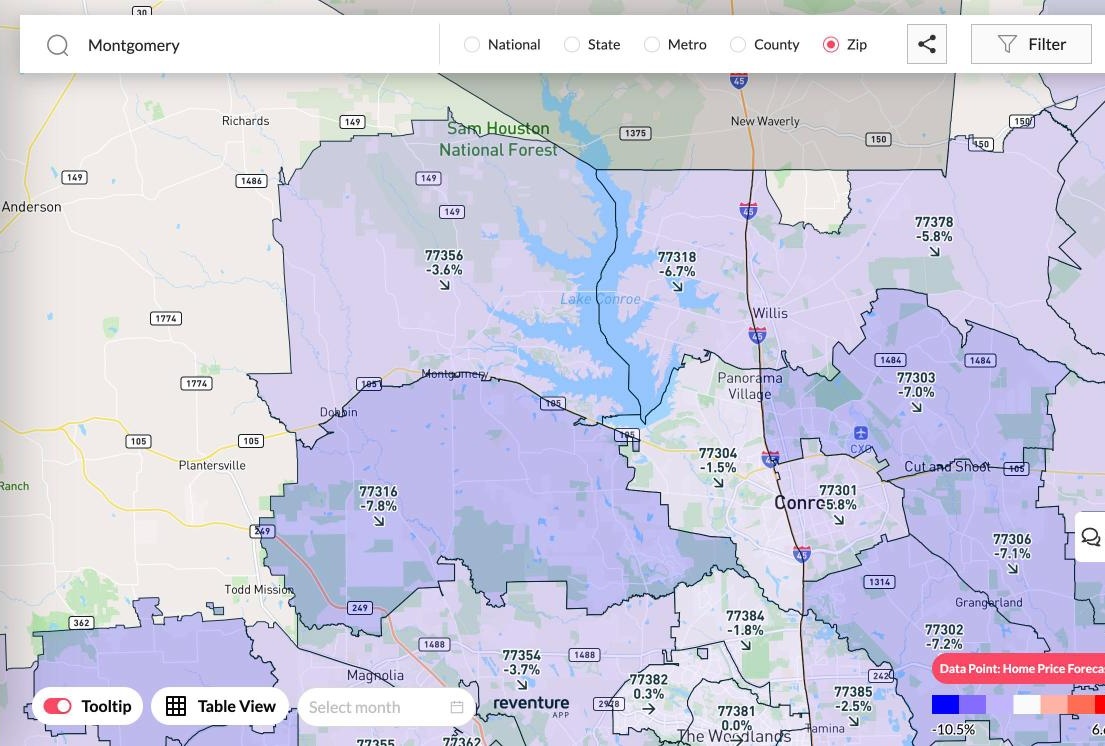
Reventure forecasts home values in Montgomery, Texas (ZIP 77316) to fall 7.8% over the next year, with most nearby ZIP codes also declining. Source: Reventure App.
Step 2: Compare price per square foot to resale comps
Divide the list price by the square footage, then compare it with recent sales of similar existing homes nearby. New homes have historically sold at a premium, so if a builder’s price per foot is at or above resale comps in a falling market, there is room to negotiate.
Step 3: Target inventory homes and stale listings
Finished homes that have sat for 60 days or more cost the builder money every month in interest, taxes and upkeep. These “spec” homes, and homes released after a cancellation, are where builders give the most. Ask the sales office which homes are complete and how long each has been listed.
Step 4: Decide between a price cut and a rate buydown
Builders often prefer to pay for a lower mortgage rate rather than cut the price. Ask for both options in writing, compare the monthly payment and the total cost, and choose based on how long you plan to stay. The next section shows the math.
Step 5: Ask for closing costs, upgrades and lot premiums
If the builder won’t move on price, ask for value elsewhere: closing cost credits, design-center upgrades, a waived lot premium, appliances, window coverings or landscaping. These cost the builder less than their retail value and don’t lower the community’s comps.
Step 6: Run the rent test
Compare the monthly cost of owning with what the home would rent for. If owning costs far more, the price is too high for the local market. The Reventure listing analyzer shows rental comps, cap rate and a suggested offer range for any listing. We look for a cap rate of at least 5%, which beats the 10-year Treasury.
Step 7: Bring your own lender quote and an agent
Builder-affiliated lenders often tie incentives to using them. Get an outside quote so you can compare the true rate and fees. A buyer’s agent costs you little or nothing in most new-home sales, and an agent who knows local comps can push harder than a buyer negotiating alone.
Price cut or rate buydown: which saves more?
A permanent rate buydown usually lowers your monthly payment more than an equal-value price cut, but a price cut is the safer choice if prices are falling. Here’s the math on a $450,000 new home with 10% down and a 30-year loan at a 7.3% market rate:
| Option | Loan | Rate | Monthly payment (principal and interest) | Saving vs. full price |
|---|---|---|---|---|
| Full price | $405,000 | 7.3% | $2,777 | — |
| 6% price cut | $380,700 | 7.3% | $2,610 | $167 a month |
| Permanent buydown to 6.3% | $405,000 | 6.3% | $2,507 | $270 a month |
| 2-1 temporary buydown | $405,000 | 5.3% in year 1, 6.3% in year 2, then 7.3% | Lower for 2 years only | Ends in year 3 |
Example adapted from The Mortgage Reports; payments checked independently.
How to choose:
- Choose the price cut if your ZIP code is forecast to fall, if you might sell within a few years, or if you expect to refinance when rates drop. A lower price also lowers your property taxes and protects your equity.
- Choose a permanent buydown if you plan to stay for many years and want the lowest payment now. Ask the builder what the buydown costs them in dollars, then ask for the same amount as a price cut and compare.
- Be careful with temporary buydowns. A 2-1 buydown makes the first two years easier, but you must qualify for and afford the full payment from year three.
Builder incentives are already making a difference: in the third quarter of 2026, buyers of new homes paid an average 6.19% on 30-year loans, compared with 6.68% for buyers of existing homes, according to Realtor.com data reported by RealEstateNews. Some large builders have also shifted buyers into FHA loans to keep payments down, as we covered in D.R. Horton’s mortgage strategy just changed.
When is the best time to negotiate with a home builder?
The best time to negotiate with a home builder is near the end of a quarter or fiscal year, and in the slow months from November through February. Builders report sales and closings to investors every quarter, and unsold finished homes hurt those numbers.
- Year-end and quarter-end. Sales teams often have targets for homes closed by a deadline. Ask whether a home can close before the end of the quarter, and what the builder would offer to make that happen.
- Winter. Fewer buyers shop between Thanksgiving and early spring, so a serious offer stands out.
- After a cancellation. A home that comes back on the market after a buyer backs out is often discounted quickly. With cancellation rates as high as they are, these are worth asking about.
Timing also matters across markets. Builder discounts are deepest where supply is highest. In October 2026, inventory was furthest above normal in Tennessee (54%), Colorado (53%), North Carolina (48%), Arizona (46%) and Utah (45%), with Texas at 39% and Florida at 27%, according to Reventure App data. In Florida, some new builds have already dropped six figures, as we covered in Is the Florida Housing Market Going to Crash?, and builders south of Nashville have pulled unsold condos to rent them instead, as shown in our Nashville housing market forecast.

Inventory is furthest above normal in Tennessee (54%), Colorado (53%), North Carolina (48%) and Arizona (46%), where builder discounts are deepest. Source: Reventure App.
Example: how to negotiate with a home builder near Houston
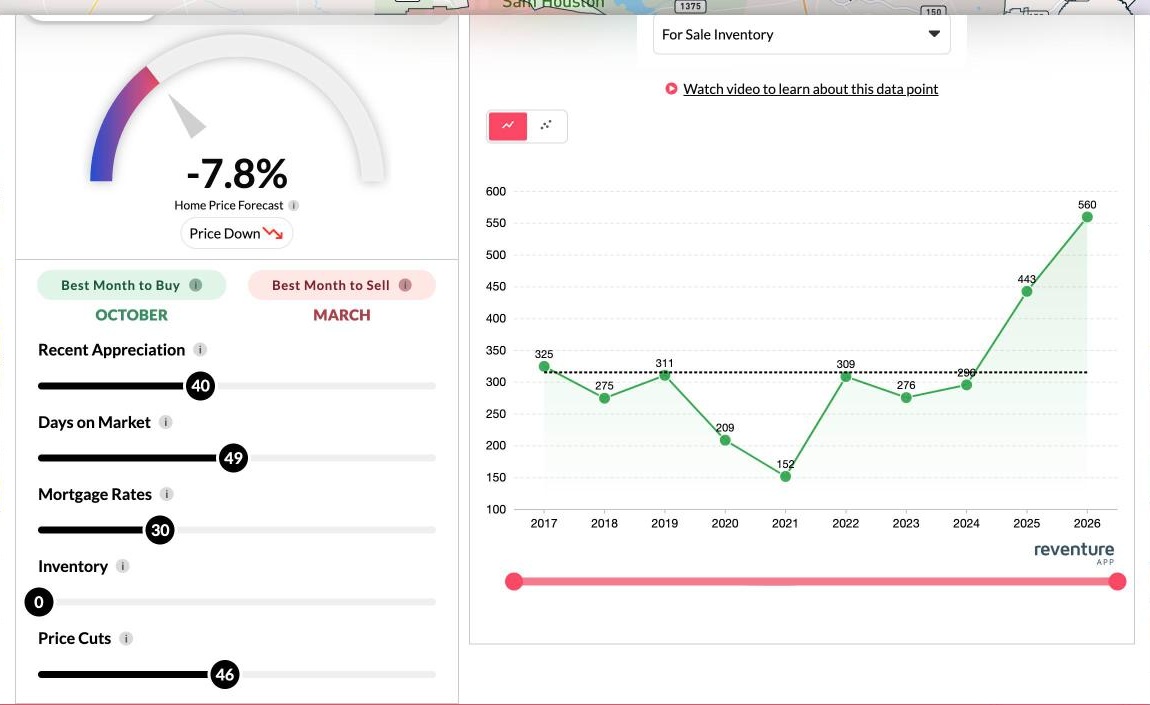
ZIP 77316 has 560 homes for sale, the most since at least 2017, and a -7.8% one-year price forecast. Source: Reventure App.
Here’s how these steps apply to a real listing Reventure analyzed in Montgomery, Texas, a suburb north of Houston:
| Factor | What the data showed | What it means |
|---|---|---|
| Home | 5 bed, 3 bath new build, about 2,650 sq ft, listed at $307,000 | About $116 per sq ft |
| Resale comps | About $118 per sq ft | Priced fairly against comps, so the leverage comes from elsewhere |
| ZIP code forecast | -7.8% over the next year for ZIP 77316; values already down 2.5% | You would likely lose equity buying at list price |
| Days on market | Listed for months, with price cuts; 560 homes for sale in the ZIP, the most since at least 2017 | The builder is motivated |
| Rent test | Rents for about $2,200 a month, a cap rate of about 4.3% | Below the 5% target, so the price is still high |
| Listing analyzer | Market offer around $282,000; conservative offer around $270,000 | A data-backed opening offer |
A reasonable approach would be to open near $270,000 to $282,000 and then trade price for incentives. For example, a builder that won’t go below $295,000 might agree to a mortgage rate near 4.9%, which could lower the payment more than a further price cut. Every number in the ask comes from data the builder can check, which makes it harder to dismiss.
This example comes from the analysis in Reventure’s Pulte Home CEO video. Listings change quickly, so check current prices before you rely on any figure.
Mistakes to avoid when you negotiate with a home builder
- Walking into the sales office first without an agent. Many builders won’t pay an agent’s commission if you registered on your own first visit.
- Focusing only on the base price. The best deal is often a mix of price, rate and closing costs. Compare total cost, not just the headline number.
- Taking the builder’s lender without comparing. Incentives tied to the in-house lender can hide higher fees. Get an outside quote.
- Ignoring the local forecast. A discount means little if the ZIP code is forecast to keep falling. Check it first on the Reventure map.
- Skipping the inspection. New homes still have defects. Pay for an independent inspection before closing, and again before the warranty ends.
- Not getting it in writing. Every price cut, incentive and upgrade should be in the purchase contract before you sign.
If you’re still deciding whether to buy at all, start with our guide to whether now is a good time to buy a house.
Frequently asked questions
Can you negotiate with a home builder on price?
Yes. In November 2026, 46% of builders were cutting prices, by about 6% on average. Builders resist visible base-price cuts because they lower community comps, so incentives such as rate buydowns and closing credits are often easier to get.
How much can you negotiate off a new construction home?
About 6% is the current average builder price cut, according to NAHB’s November 2026 survey. Finished homes that have sat for months, homes in ZIP codes forecast to fall, and quarter-end deals can justify asking for more, especially when you combine a price cut with incentives.
Is a rate buydown better than a price cut?
It depends on how long you’ll keep the home. On a $450,000 home, a permanent buydown from 7.3% to 6.3% saves about $270 a month, versus about $167 for a 6% price cut. A price cut protects your equity if prices fall and keeps its value if you refinance later.
Do you need a real estate agent to negotiate with a home builder?
You don’t need one, but it usually helps and the builder typically pays the commission. Bring your agent on your first visit, since some builders won’t pay an agent who wasn’t registered from the start.
When is the best time to buy new construction?
Late in the year and at the end of a builder’s quarter, when sales teams are trying to hit closing targets. Winter months also have fewer buyers, which gives you more leverage.
Sources
- Builders Cut Prices at Record Pace as Confidence Hits 14-Year Low, The Mortgage Reports, NAHB/Wells Fargo Housing Market Index, November 2026
- Builders slash prices as confidence craters to a 14-year low, Inman
- Buyers are getting lower rates on new home purchases, RealEstateNews, Realtor.com Q3 2026 data
- Builder rate incentives give new-home buyers a 114-basis-point edge, National Mortgage Professional
- Pulte Home CEO hits ALARM (worst crisis in 19 years), Reventure Consulting: PulteGroup, D.R. Horton and LGI Homes figures, and the Montgomery, Texas example
- Reventure App forecasts and listing analyzer