A Florida housing market crash is already underway in parts of the state. Statewide, Florida home values are down about 7% from their 2022 peak, which is a correction rather than a crash. But in Southwest Florida metros like Cape Coral, Punta Gorda, and North Port, values have fallen 15% to 22%, and individual sellers are taking losses of 30% to 40%. Those are 2008-level declines.
Check your ZIP code’s 2027 forecast on the Reventure map before you buy or list in Florida. The gap between neighborhoods is as wide as the gap between metros.
Key takeaways
- A Florida housing market crash is already underway in specific metros, led by Punta Gorda (down about 22% from peak) and Cape Coral (down about 16%).
- Net domestic migration into Florida collapsed 93%, from 310,892 people in 2022 to 22,517 in 2025.
- Florida posted the nation’s highest foreclosure rate in the first half of 2026, with Punta Gorda, Lakeland, and Cape Coral among the hardest-hit metros.
- Voters approved Amendment 3 on November 3, 2026, cutting property taxes for homesteaded owners starting in 2027.
- Reventure’s data now shows Cape Coral entering undervalued territory, yet still forecasts further price declines — which is exactly the window in which patient buyers get the best deals.
Is the Florida housing market crashing in 2026?
It depends entirely on where you look. Statewide the answer is no. In Southwest Florida the answer is clearly yes.
Florida home values are down roughly 7% from their 2022 peak statewide and about 2.5% over the past year, according to Reventure’s analysis. A 7% statewide decline is a correction. It is painful for recent buyers, but it is not a crash.
The metro-level numbers tell a different story. Here is how the hardest-hit U.S. markets rank by home value change over the past four years:
| Rank | Metro | Change from peak |
|---|---|---|
| 1 | Austin, TX | -26.7% |
| 2 | Punta Gorda, FL | -22% |
| 3 | Cape Coral-Fort Myers, FL | -16% |
| 4 | North Port-Sarasota, FL | -15% |
| 5 | New Orleans, LA | -11% to -12% |
| 6 | Phoenix, AZ | -10% |
Source: Reventure App, four-year change in home values.
Four of the six worst-performing markets in the country are in Florida or on the Gulf Coast. Independent data agrees on the direction. Federal and industry sources show four of the five U.S. metros with the biggest price drops between January 2025 and January 2026 were in Southwest Florida. ATTOM’s Q1 2026 data put the Cape Coral-Fort Myers median at $341,250, down 9% year over year and the largest decline of any major U.S. metro.
Why metro averages understate the pain
This is the part most coverage misses. When a metro average falls 16%, that average contains sellers who lost nothing and sellers who lost 40%.
Downturns are never evenly distributed. Within Cape Coral, some neighborhoods are down 15% while others are down 25%. The owner who bought a well-located home in 2019 may still be ahead. The owner who bought a new build at the 2022 peak with a high mortgage balance may be deeply underwater.
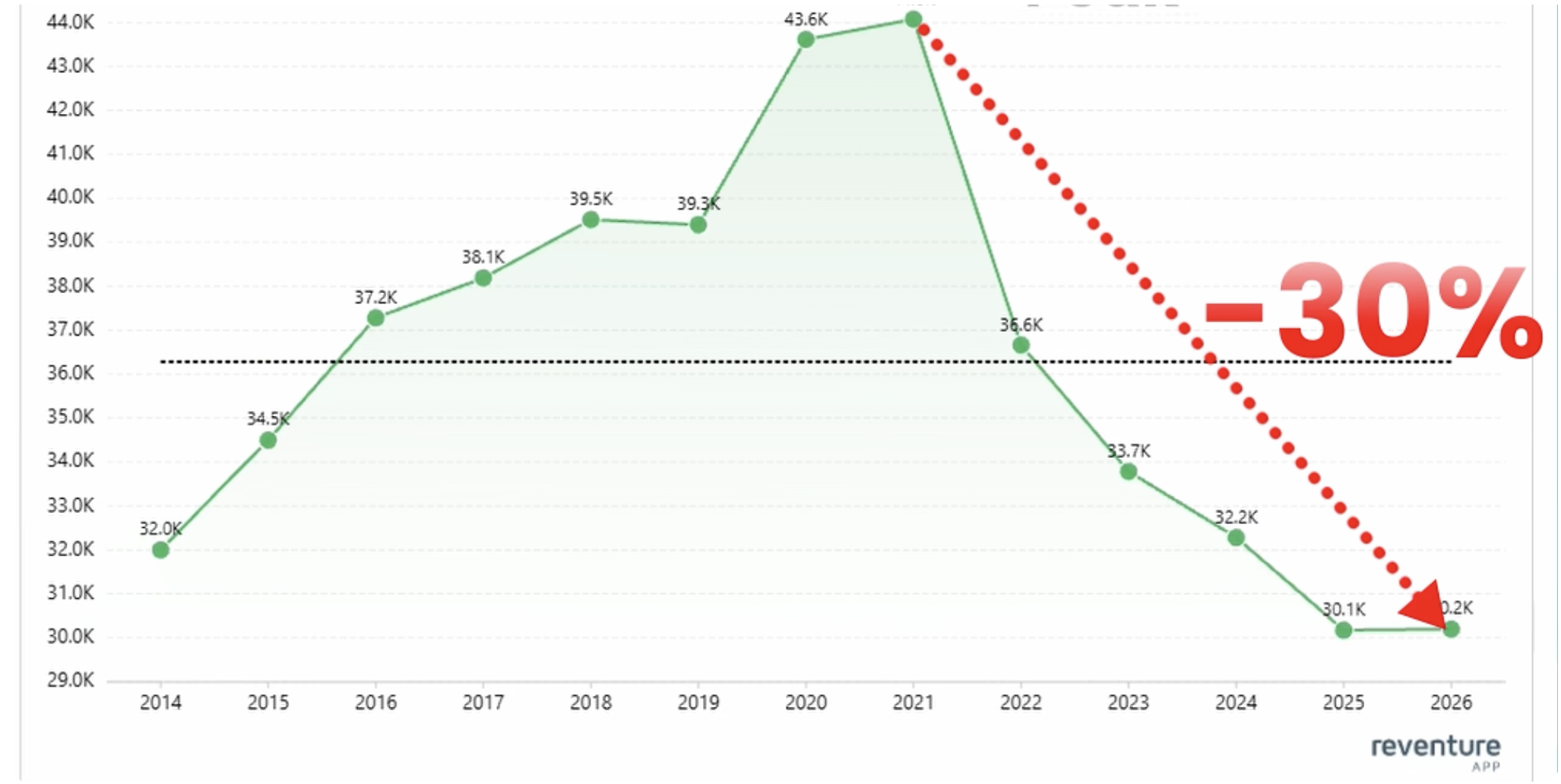
That is why a statewide or even metro-level number is close to useless for an individual decision, and why ZIP-level data matters so much in a market like this one.
Where are Florida home prices falling the fastest?
The Gulf Coast is the epicenter. The Atlantic side and South Florida have held up far better.
| Region | Direction | Notes |
|---|---|---|
| Southwest Gulf Coast (Cape Coral, Fort Myers, Punta Gorda, North Port, Sarasota) | Falling hardest | 15% to 25% metro declines from peak |
| Naples | Falling | Down about 10% from peak |
| Tampa Bay and Central Florida | Falling modestly | Lee, Hillsborough, Pinellas, and Orange counties all negative year over year |
| Palm Beach | Recovering | Fell, then turned up over the past six months |
| Miami-Dade | Holding | Still up double digits since mid-2022 |
Sources: Reventure App; county-level MLS data for the 12 months ending August 2026.

Reventure’s year-over-year map shows essentially every part of Florida in negative territory. No region of the state has fully escaped the downturn. The difference is one of severity, not direction.
Two hurricanes explain much of why the Gulf Coast was hit hardest. Hurricane Ian struck in 2022 and Hurricane Milton in 2024. Both accelerated an existing downturn by suppressing migration, raising insurance costs, and adding distressed supply to the market.
Why is the Florida housing market falling?
Four forces are working at once, and none of them is likely to reverse quickly.
1. Migration collapsed
This is the single biggest driver. Florida’s pandemic boom was built on people moving in from other states, and that flow has nearly stopped.
| Year | Net domestic migration into Florida |
|---|---|
| 2022 | 310,892 |
| 2023 | 183,646 |
| 2025 | 22,517 |
Source: U.S. Census Bureau estimates.
That is a 93% decline from the 2022 peak. Florida led the nation in net domestic migration for three straight years and now ranks eighth, behind Alabama.

An honest caveat: Florida’s population is still growing. The state added roughly 196,000 people in 2025, driven by international migration, which led the nation at 178,674, plus natural increase. People are not fleeing Florida. The state simply stopped receiving the enormous wave of domestic buyers that pushed prices up 50% to 60% in two years.
2. Local incomes can’t support the prices
When out-of-state buyers stop arriving, prices have to be supported by local wages. Florida’s median household income is about $80,000 statewide and closer to $70,000 in the Cape Coral area.
That is not enough to comfortably carry a mortgage, taxes, and insurance on a $400,000 to $500,000 home at rates above 7%. Prices have fallen meaningfully and are still beyond what most local buyers can afford, which is why demand has not rebounded.
3. Demand has fallen well below normal
Florida recorded about 32,100 home sales in July 2026. That is roughly 30% below the pandemic peak, 20% below 2019, and about 11% below the long-term average.
Falling prices have not yet brought buyers back, which is the defining feature of this downturn.
4. Builders kept building
Construction in Cape Coral is still running above pre-pandemic levels despite the correction. New supply arriving into weak demand puts continued downward pressure on resale prices, and builders discounting to clear inventory sets the comparable sales that everyone else is measured against.
What does the Florida housing crash look like on the ground?
Statistics understate this. Reventure’s team filmed in Cape Coral, the epicenter of the downturn, and the individual listings are the clearest evidence of what a 16% metro decline actually means. You can watch the full walkthrough here.
Real losses on real listings
| Property | Purchase | Current list price | Loss |
|---|---|---|---|
| Cape Coral single-family (short sale) | $480,000 in 2022 | $325,000 | -$155,000 |
| Cape Coral single-family (short sale) | ~$340,000 at peak | $230,000 | -$110,000 |
| Cape Coral single-family (short sale) | $260,000 in 2024 | $185,000 | -$75,000 |
| Fort Myers 2-bed, 2-bath condo | $800,000 in 2023 | $440,000 | -$360,000 |
These are not projections. They are people who bought near the peak with mortgage debt, are now underwater, and are selling at a loss before the lender forecloses.
The visual signs of a downturn
Driving through Cape Coral, several things stand out that have not been common in U.S. housing since 2008:
- Half-built homes. Multiple properties sit partially framed, some without roofs, with no visible sign of ongoing construction.
- Abandoned building lots. Vacant lots bought for development and then walked away from.
- “100% financing available” signs in front of new builds, a lending posture most people associate with the last cycle.
- Clusters of distress. On a single street: a vacant rental, a half-built house, a short sale, and a vacant lot for sale.
- New builds listed at $340,000 to $430,000, well below what equivalent homes fetched three years ago.
Rents are falling too
A three-bed, two-bath, 2,200-square-foot rental in Cape Coral has been cut to roughly $1,900 a month, with one month free offered as an incentive. The same home rented for about $1,700 in 2017. That is a $200 increase over nearly a decade, while prices roughly doubled and came partway back.
This matters for buyers because rents are the clearest real-time signal of genuine demand. When rents stall and prices fall toward them, the market is repricing to fundamentals. It is the same rent test we applied to Nashville in Is the Housing Market Going Down?, running in Florida’s favor as a buyer.
Amateur builders are getting wiped out
Bloomberg reported on inexperienced flippers in Cape Coral who bought vacant lots for $30,000 to $50,000 and funded construction with hard money loans at around 90% leverage and 8% interest. That math worked while values rose. With values falling, a home they expected to sell for $450,000 to $500,000 might now fetch $350,000 to $400,000. A local building and mortgage expert quoted in the piece estimated losses of roughly $75,000 per property.
Are foreclosures rising in Florida?
Yes, and faster than anywhere else in the country. Florida posted the nation’s highest foreclosure rate in the first half of 2026, with one in every 373 housing units receiving a filing. Punta Gorda, Lakeland, and Cape Coral ranked among the metros with the most filings.
Nationally, 227,548 properties had foreclosure filings between January and June 2026, up 21% year over year. Monthly Florida filings have run 22% to 45% above the prior year throughout 2026, according to Florida Court Clerks data compiled by the University of Florida’s Shimberg Center.
Two things to keep in mind. First, foreclosure levels remain below historic norms nationally, so this is a sharp rise from a low base rather than a return to 2010. Second, part of the increase reflects pandemic-era moratorium backlogs finally clearing the courts. But analysts attribute the Florida-specific surge to the state’s price run-up, shifted migration patterns, and cooling demand.
What short sales mean for buyers
A short sale happens when an owner who is behind on the mortgage sells for less than the loan balance, with lender consent, to avoid foreclosure. These are where the deepest discounts in Florida sit right now, but they come with a catch worth understanding:
- Lender-approved short sales have a price the bank has already signed off on. Closing is relatively fast.
- Non-lender-approved short sales have not been priced by the bank. You can go under contract and still face renegotiation afterwards, and closing can take three to four months.
If you are shopping distressed inventory in Florida, ask which type you are looking at before you write an offer.
Will Florida’s property tax cut help the housing market?
Florida voters approved Amendment 3 on November 3, 2026, with about 62% of the vote, above the 60% threshold required. It is the largest change to Florida’s property tax system in years, and it takes effect January 1, 2027.
What Amendment 3 does
| Year | Homestead exemption for non-school property taxes |
|---|---|
| 2026 (current) | $50,000 |
| 2027 | $150,000 |
| 2028 | $250,000 |
| 2029 onward | Indexed to inflation |
Source: Florida Division of Elections; Florida Chamber of Commerce.
Key details for buyers:
- School taxes are unchanged. The larger exemption applies only to non-school taxes: county, city, police, fire, emergency services, libraries, and parks.
- Estimated savings are roughly $1,300 per eligible homeowner in 2027, rising to about $2,700 in 2028.
- There is a residency requirement. People who were not Florida residents as of December 31, 2026, receive the existing $50,000 exemption for their first four years and the increased exemption beginning in year five. You cannot move to Florida next year and claim the full benefit immediately.
- It applies to primary residences only. Second homes, investment properties, and commercial property do not qualify.
Will it reverse the downturn?
Probably not on its own. Expect a modest uptick in demand entering 2027 as buyers price in lower carrying costs, and the savings are meaningful for lower-priced homes, where a 40% cut to a tax bill materially changes the monthly payment.
But the underlying problems remain. Prices are still high relative to local incomes, migration is still far below its peak, insurance costs remain among the highest in the country, and the residency rule means the measure does nothing to attract new out-of-state buyers for five years. Local governments also expect significant revenue reductions by 2028, which carries its own second-order effects.
Is now a good time to buy in Florida?
It is a good time to start making offers, especially on distressed inventory, as long as you build further declines into your price.
Reventure’s valuation metrics now show Cape Coral entering undervalued territory, meaning prices have fallen far enough relative to local incomes and rents to look reasonable by historical standards. At the same time, Reventure’s forecast still calls for further declines over the next 12 months.
That combination is unusual and it favors patient buyers. An undervalued market that is still falling is where the best deals get made, provided you negotiate as though the forecast is right rather than hoping it is wrong.
How to approach a Florida purchase right now:
- Check your specific ZIP code, not the metro. On the Reventure map, ZIP codes forecast to rise can still see bidding wars, even inside Palm Beach and Miami-Dade. ZIP codes forecast to fall give you room to negotiate.
- Target distressed and stale inventory. Short sales, listings carrying multiple price cuts, and builder inventory sitting unsold are where sellers actually transact.
- Price the forecast into your offer. If your ZIP code is forecast to fall another 5% to 10%, an offer at today’s asking price means absorbing that decline yourself. The negotiation approach in Is Now a Good Time to Buy a House? applies directly here.
- Budget insurance and HOA costs properly. Florida insurance premiums run far above the national average, and post-Surfside condo reserve requirements have triggered large special assessments. A cheap purchase price can hide an expensive carry.
- Confirm your Amendment 3 eligibility. If you are moving from out of state, you are on the $50,000 exemption for four years.
The risk nobody has priced in
Here is what should give buyers pause. Florida has already corrected 7% statewide and 16% in Cape Coral without a recession. Unemployment is still near 4% and the stock market is near record highs.
Southwest Florida is a retirement destination with a large population living on fixed incomes and investment portfolios. If equities corrected meaningfully or unemployment rose a couple of percentage points, the downside in these markets could extend well beyond current forecasts. That is an argument for negotiating hard, not for avoiding the market entirely.
Will the Florida housing crash spread to the rest of the country?
It is already spreading, though unevenly. The same forces hitting Florida — fading pandemic migration, heavy overbuilding, and prices that outran local incomes — are present across the Sun Belt and Mountain West.
Austin is further along than any Florida metro, down 26.7% over four years. Phoenix is down about 10%. Reventure forecasts declines of up to 10% over the next year in parts of Nashville, Denver, and Dallas, where inventory sits at or near record highs.

The counterweight is that a handful of markets are moving the other way. Manhattan, San Francisco, Chicago, and their wealthy suburbs are appreciating as jobs concentrate back into coastal hubs. We covered that reversal in Is Manhattan Real Estate a Good Buy in 2027? and the national split in Will Housing Prices Drop in 2027?.
What happens in Cape Coral over the next year is worth watching for everyone, not just Florida buyers. It is the furthest along of any major Sun Belt market and the closest thing available to a preview of how these corrections resolve.
Frequently asked questions
Is the Florida housing market going to crash?
Parts of it already have. Statewide values are down about 7% from peak, which is a correction. But Punta Gorda is down roughly 22%, Cape Coral about 16%, and individual sellers in those markets are taking 30% to 40% losses.
Where are Florida home prices falling the most?
Southwest Florida’s Gulf Coast: Punta Gorda, Cape Coral, Fort Myers, North Port, and Sarasota. Naples is down about 10%. Miami-Dade has held up best and remains up double digits since mid-2022.
Why are Florida home prices falling?
Net domestic migration fell 93% from its 2022 peak, local incomes cannot support current prices, home sales are running about 20% below 2019 levels, builders kept adding supply, and two hurricanes accelerated the decline on the Gulf Coast.
Are people leaving Florida?
No. Net domestic migration fell sharply but stayed positive, and the state added roughly 196,000 people in 2025 through international migration and natural increase. The wave of out-of-state buyers that drove the boom has slowed to a trickle, which is different from an exodus.
Will Florida property taxes go down in 2027?
Yes, for homesteaded owners. Amendment 3 passed with 62% of the vote on November 3, 2026, raising the non-school homestead exemption to $150,000 in 2027 and $250,000 in 2028. Estimated savings are about $1,300 in 2027 and $2,700 in 2028. New Florida residents wait four years for the full benefit.
Is it a good time to buy a house in Florida?
It is a good time to make offers, particularly on short sales and stale listings, if you price in further declines. Reventure’s data shows Cape Coral is now undervalued yet still forecast to fall, which favors buyers who negotiate rather than those who pay asking.
Is this like 2008?
In specific Florida neighborhoods, the mechanics look similar: underwater owners, short sales, foreclosure surges, half-built homes, and aggressive financing offers. Nationally it is not comparable. Homeowner equity is far higher, lending standards are tighter, and overall delinquencies remain near pre-pandemic levels.
Sources
- Fortune: Florida’s tax cut plan and the migration collapse
- Homes.com: Florida sees sharpest foreclosure rise in first half of 2026
- CBS News: Home prices dropped in dozens of big U.S. cities
- HousingWire: Florida homebuilding in a choppy 2026
- Florida Chamber of Commerce: Amendment 3 summary and implementation timeline
- News4Jax: Florida voters pass Amendment 3, reject two other amendments
- Bay News 9: Florida voters approve Amendment 3
- University of Florida Shimberg Center: Florida foreclosure and eviction filings
- Reventure: on the ground in Cape Coral (video)
- Reventure App: 2027 ZIP code price forecasts, four-year home value change rankings, valuation metrics, and Florida sales data