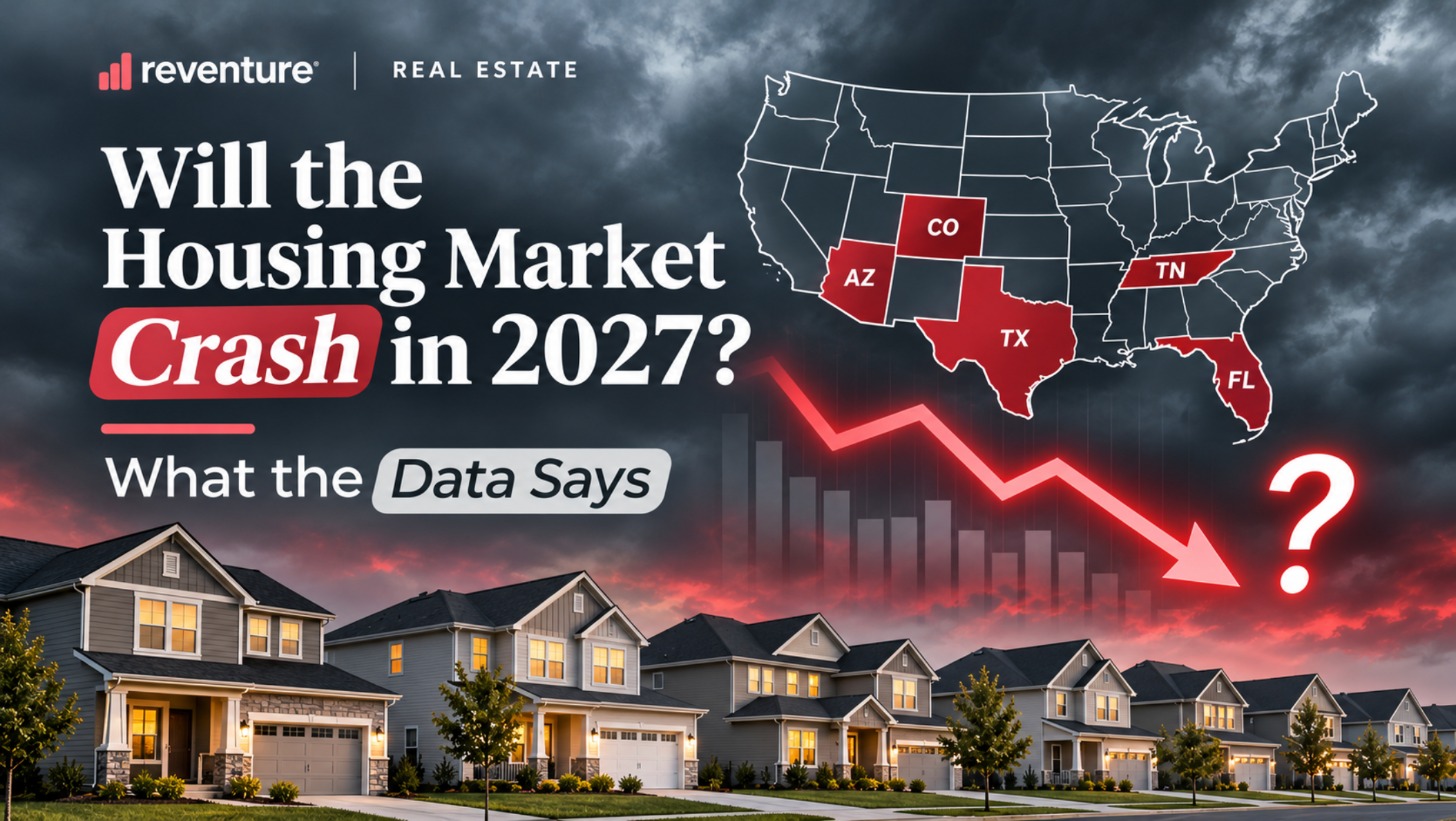
Will the housing market crash in 2027? Not nationally, based on today’s data, but parts of the country are already in a correction that could deepen. Home sales just fell to their lowest level since 2010 and inventory is the highest in a decade, yet national prices are roughly flat because most owners have large equity cushions and low mortgage rates. The biggest drops are likely in oversupplied Sun Belt markets, where Reventure forecasts declines of up to 10%.
Key Takeaways:
- Demand has collapsed. Existing-home sales hit a 3.75 million annual pace in October 2026, the slowest since August 2010, and pending sales set a second straight record low.
- Prices haven’t crashed. The national median existing-home price was $416,700 in October, up 0.4% from a year earlier, while Redfin’s measure is down 0.9%.
- A 2008-style crash is unlikely. Only about 2% of mortgaged homes are underwater, and distressed sales are just 2% of transactions.
- The risk is regional. Inventory is 45% to 54% above normal in Tennessee, Colorado, North Carolina, Arizona and Utah, where prices are most likely to keep falling.
Will the housing market crash in 2027?
No, a national crash is unlikely, but a slow, uneven decline is already underway. The answer depends on what you mean by “crash”:
| Term | What it means | Is it happening? |
|---|---|---|
| Housing crash | National prices fall 20% or more in a short time, driven by forced selling. In 2007-2011, prices fell more than 25%. | Not nationally. Distressed sales are only 2% of transactions. |
| Correction | Prices fall roughly 5% to 15% as supply outpaces demand, usually over several years. | Yes, in much of the South and West. |
| Stall | Sales collapse but prices stay flat because sellers hold out. | Yes, nationally. Sales are at a 16-year low while prices are flat. |
So when people ask “will the housing market crash in 2027?”, the honest answer is: the national market is stalling, and the oversupplied markets are correcting. We break down the national price outlook in Will Housing Prices Drop in 2027? and where prices are still rising in Is the Housing Market Going Down?
Is the housing market going to crash? What the data shows right now
The housing market is in its weakest demand period in decades, but prices are holding up better than sales. Here is where the key indicators stand:
| Indicator | Latest reading | Change from a year ago |
|---|---|---|
| Existing-home sales (Oct 2026) | 3.75 million annual pace, lowest since August 2010 | Down 8.8% |
| Pending home sales index (Oct 2026) | 63.0, a record low for the second month in a row | Down 16.7% |
| Homes for sale (Oct 2026) | 1.59 million | Up 4.6% |
| Months of supply (Oct 2026) | 5.1, highest since November 2015 | Up from 4.4 |
| Median existing-home price (Oct 2026) | $416,700 | Up 0.4% |
| 30-year mortgage rate (Oct 2026 average) | 7.33% | Up from 6.25% |
| Mortgage purchase applications (week of Nov 6) | Down 18% | |
| Builder confidence (Nov 2026) | 25, lowest since April 2012 |
Sources: NAR existing-home sales, NAR pending home sales, MBA via RealEstateNews, NAHB via The Mortgage Reports.
Three things stand out:
- Buyers have disappeared. NAR’s chief economist, Lawrence Yun, says annual sales could be the lowest since the mid-1990s. Every one of the 50 largest metros saw pending sales fall from a year ago.
- Supply is back. Months of supply has crossed 5, the edge of a buyer’s market. We showed how fast the shortage faded in the U.S. housing shortage is fading.
- Prices are flat, not falling sharply. The median is still up slightly nationally, but it’s down 0.4% in the South, and sales in the West hit a record low.
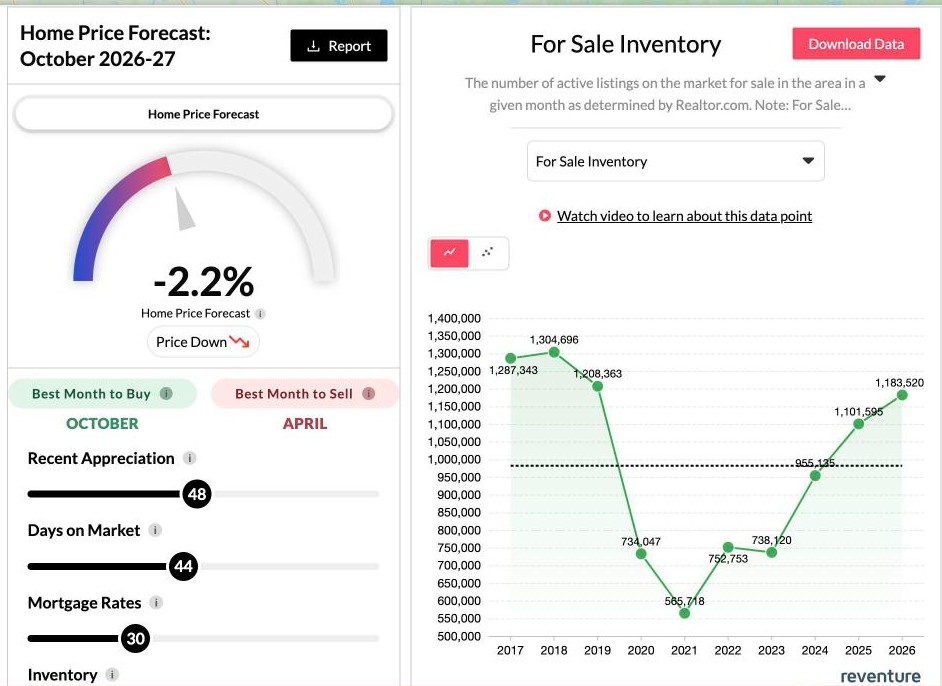
Reventure forecasts U.S. home values to fall 2.2% over the next year, while active listings have climbed back to about 1.18 million. Source: Reventure App.
Why a 2008-style crash is unlikely
To see why the answer to “will the housing market crash in 2027” is likely no, compare today with 2008. That crash was driven by forced selling: owners with little equity and risky loans lost their homes all at once. Today’s owners are in a much stronger position.
- Large equity cushions. Homeowners held $17.9 trillion in equity in the second quarter of 2026, with an average loan-to-value ratio of 44%. Only about 2.1% of mortgaged homes were underwater, according to Cotality data cited by Home Buying Institute.
- Locked-in low rates. Roughly half of outstanding mortgages carry a rate below 4%, so most owners have no reason to sell and every reason to stay.
- Low distress. Distressed sales are only 2% of all transactions, according to NAR. Yun describes the 88 million U.S. homeowners as largely in a comfortable financial position.
- Foreclosures are rising from a low base. ICE reported foreclosure starts at a six-year high in June 2026, but foreclosure sales were still 46% below pre-pandemic levels, according to its June mortgage report.
That is why the more likely 2027 scenario is a long stall: few sales, slowly rising inventory, and price cuts concentrated where supply is highest. It’s also why the real problem is that prices are too high relative to incomes and rents, not that owners are about to default, a point we made in Will Housing Prices Drop in 2027?
Will the housing market crash in 2027 in your area?
It depends heavily on where you live. Prices are falling fastest where inventory has climbed furthest above normal, mostly in pandemic boomtowns across the South and West. In October 2026, Reventure App data showed inventory this far above normal:
| State | Inventory vs. normal | What to expect |
|---|---|---|
| Tennessee | +54% | Continued price cuts, especially condos |
| Colorado | +53% | Continued price cuts |
| North Carolina | +48% | Softening |
| Arizona | +46% | Softening |
| Utah | +45% | Softening |
| Texas | +39% | Builder-driven discounts |
| Florida | +27% | Sharp declines in some metros |
| Illinois | -26% | Prices still rising |
| New York | -9% | Prices still rising |
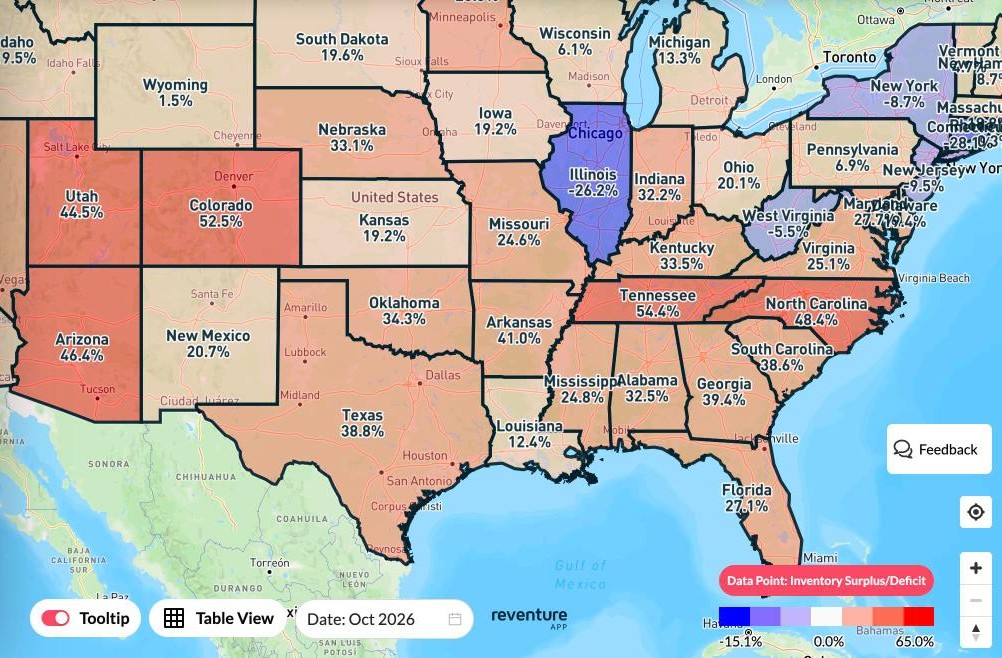
For-sale inventory vs. pre-pandemic normal by state, October 2026: red states have the biggest surpluses, blue states still have shortages. Source: Reventure App.
Some local markets already look like a crash:
- Southwest Florida. Cape Coral, Punta Gorda and North Port are down 15% to 22% from their peaks, as we covered in Is the Florida Housing Market Going to Crash?
- Nashville. Reventure forecasts the metro to fall 7.6% over the next year, with downtown condos (ZIP 37203) forecast to drop 9.7%. See our Nashville housing market forecast.
- New-build suburbs. Builders are cutting prices at the fastest pace since 2012, which is pulling down nearby resale values. Our guide on how to negotiate with a home builder shows how buyers can use this.
Meanwhile, the Northeast and Midwest are still rising. The Northeast median price was up 3.2% from a year ago in October, and Manhattan is one of the few markets Reventure rates a buy, as we explained in our Manhattan real estate forecast.
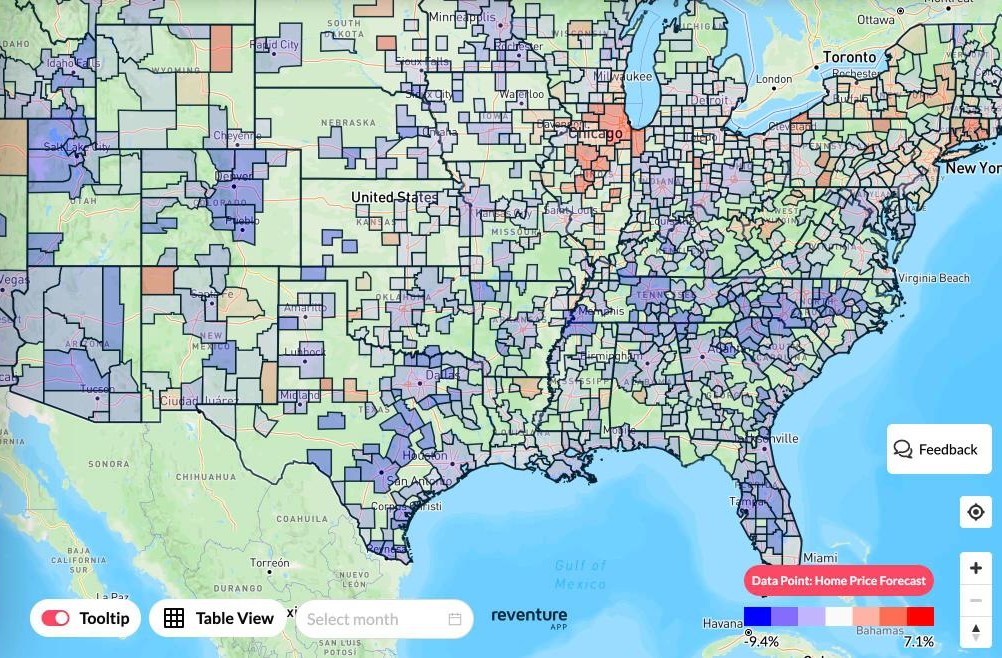
1-year home price forecast by metro: blue areas are expected to fall (by up to about 9%), red areas to rise. Source: Reventure App.
Check your ZIP code: see the 2027 forecast for your area on the Reventure forecast map.
What could still cause a housing crash?
A crash would need forced selling, and forced selling needs a shock that pushes owners out of their homes. Three risks are worth watching:
- A jump in unemployment. The job market is still holding, with unemployment at 4.1% in October 2026. A recession that pushed it sharply higher is the main way equity-rich owners could be forced to sell.
- A stock market drop. Retirees and investors in places like Florida, Arizona and the Carolinas rely heavily on their portfolios. Reventure has warned that a pullback in AI spending could hit those buyers first, as covered in MASSIVE AI default warning.
- Mortgage rates staying above 7%. Rates averaged 7.33% in October, the highest since 2000 apart from one month in 2023. If they stay there, more owners who need to move will have to sell into a market with fewer buyers.
If none of these hits hard, the answer to “will the housing market crash in 2027” stays no: expect falling sales, rising inventory and gradual, regional price declines instead. Yun has said rates “appear to have topped out,” which would ease some of the pressure.
What should buyers and sellers do now?
If you’re buying
You don’t need to wait for a crash to get a good deal. Buyer leverage is the strongest in Redfin’s records going back to 2013, and only 3 of the 50 largest metros are still seller’s markets. Check your ZIP code forecast first, offer below asking where supply is high, and run the numbers with the Reventure listing analyzer. Our guide to whether now is a good time to buy a house walks through the decision market by market.
If you’re selling
Price to today’s market, not last year’s. With more than five months of supply nationally, overpriced homes sit and end up selling for less after several cuts. If you’re in an oversupplied state like Tennessee, Colorado or Arizona, selling sooner is likely better than waiting for a rebound the data doesn’t support.
Frequently asked questions
Will the housing market crash in 2027 or 2028?
A national crash in either year is unlikely unless unemployment rises sharply. The more likely path is a slow decline in oversupplied markets, which could run into 2028 as inventory keeps building.
Will the housing market crash in 2027 in Florida?
Parts of Florida have already crashed. Values in Cape Coral, Punta Gorda and North Port are down 15% to 22% from their peaks. Statewide, the drop is smaller, closer to a correction.
Will the housing market crash in 2027 if mortgage rates stay high?
High rates mainly freeze the market rather than crash it. Owners with low-rate mortgages tend to stay put, which keeps forced sales low. The longer rates stay above 7%, though, the more sellers will have to cut prices to find buyers.
What are the signs of a housing market crash?
Watch for rising unemployment, a jump in mortgage delinquencies and foreclosures, distressed sales above 10% of transactions, and inventory rising while sales keep falling. Today, inventory and sales are flashing warnings, but distress is still low.
Will home prices drop in 2027?
In many markets, yes. Reventure forecasts declines of up to about 10% in the most oversupplied ZIP codes, while Reventure’s national forecast is a more modest 2.2% decline. See Will Housing Prices Drop in 2027? for the full forecast.
Sources
- Existing-home sales decreased 5.5% in October, National Association of Realtors, Nov. 12, 2026
- Pending home sales decreased 4.7% in October, National Association of Realtors, Nov. 18, 2026
- Existing-home sales haven’t been this slow since 2010, RealEstateNews (MBA and Redfin data)
- Builders Cut Prices at Record Pace as Confidence Hits 14-Year Low, The Mortgage Reports (NAHB data)
- Why a U.S. Housing Market Crash Is Unlikely in 2027, Home Buying Institute (Cotality equity data, jobs data)
- First look at June 2026 mortgage data, ICE
- MASSIVE AI default warning, Reventure Consulting
- Reventure App inventory and forecast data